Lesson 13 Working in the home garden

Garden with rows of red and yellow tulips under green trees

Working in the home garden

The simplicity of nature, with plants full of flowers in the greenery itself, provides us with a sense of beauty, peace, and security, and even strengthens our belief in Mother Nature when we take a moment to stop and appreciate our incredibly wonderful world. The miraculous sight of a tiny, delicate flower blooming among the velvety, tender leaves with shining dew droplets on them in the sweet early morning keeps us forever in a state of wonder and amazement.

But the dawn is the busiest time for mothers and children for the day, preparing food, packing bags full of books, boxes full of food, bottles full of water or drinks. Children pack themselves into school vans and leave their sweet home when flowers bloom in their gardens, smiling at the sun slowly peeking out, with no soul to admire. Even on Saturdays, most children leave their sweet home, huddle themselves in private classrooms and take down notes on how plants grow and flowers bloom, leaving flowers to bloom and fade in their gardens unnoticed. But everyone watches how wonderfully flowers bloom on the TV screen.

Working in the home garden

How to prepare a flower bed

Things needed.

A mattock

A crowbar

A rake

Extension cord

Four wedges

Some manure

Some flower plants, cuttings, or seeds
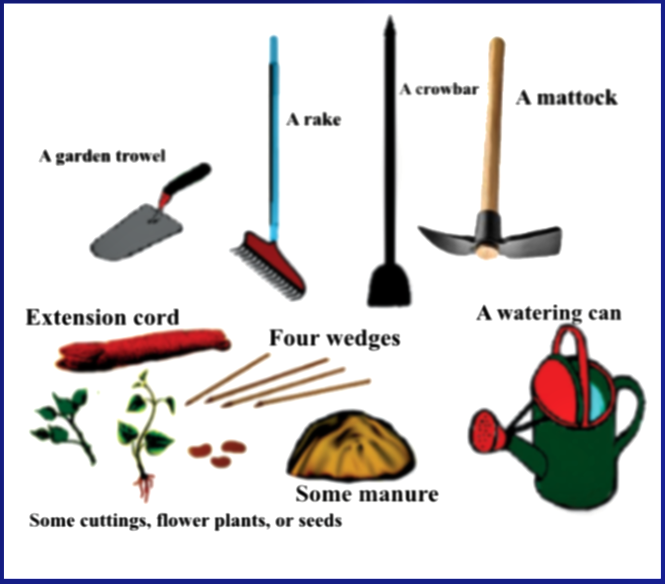
Things needed for a flower bed: trowel, rake, crowbar, mattock, extension cord, four wedges, manure, watering can

First, choose a place for the flower bed.

Mark four corners using the four wedges.

Tie the cord to the wedges.

Remove the grass cover or weeds within the marked area.

Cut the edges along the cord with the flat end of the crowbar.

Loosen the topsoil about 8 inches deep with the mattock.

Loosen the sods of earth with the rake.

If there are stones or roots, remove them with the rake or by hand.

Add enough manure.

Mix the manure and soil well.

Place bricks or stones along the boundary of the flower bed to protect soil from washing away and keep out grass and weeds.

Make holes in rows in the prepared bed for plants, cuttings, or seeds. (The number of holes should be according to the size of the plants you expect to grow)

Plant the flower plants, cuttings, or seeds in the holes.

Cover the holes with soil and press the soil lightly.

Water the flower bed.

Remove the wedges and the chord.

Put the grass and weeds into the compost barrel.

Keep the mattock, the crowbar, the rake, and the other things where they were.

Before starting your work, think about the following points.


Choose an attractive, sunny spot with a good view for your flower bed.

Start preparing the flower bed in the afternoon so that you can plant young plants, cuttings, or seeds in the evening.

You should not expose your new plants or cuttings to the hot sun.

If you replant from a nursery, water the nursery well the day before you intend to plant.

Don’t remove all the plants from their nursery and leave them exposed for long, to get withered and dry out.

Bury the plant to the depth it was in the nursery. If you bury it too deep, the stem will rot and not deep enough, the roots will dry out.

Water your newly planted bed as soon as it is planted and use sufficient water to wet the soil to settle.

Cover the soil with straw or dry leaves. It is called mulching, and mulching conserves water, blocks weeds and cools the soil. It will also improve the soil quality.

Water the flower bed regularly in the evening during the dry season.

Choose healthy plants, cuttings, or seeds for your flower bed.

If you use healthy cuttings, new shoots will appear within several days after planting.

If you plant seeds, don’t plant them too deep. It will take two to three days to germinate.

Use sufficient manure if the soil is poor.

Organic manure (compost) will help keep the soil aerated and moist at all times, as well as help feed the plants slowly.

When weeds appear, nip, prune or uproot them.



Amarasiri Ganewatta

Amarasiri Ganewatta

Director, English Language Laboratory

Amarasiri Ganewatta is the director of the English Language Laboratory. He is a retired English teacher and a language translator living in California, USA.

Email: ganewatta@gmail.com

Books by the Author

Understanding Advanced English Grammar 1 in 3D by Amarasiri Ganewatta, book cover

‘UNDERSTANDING ADVANCED ENGLISH GRAMMAR’ is the first book of a series of three books. This book begins with the introduction of the three dimensions of the English language. It is an innovative method of teaching Active Voice, Passive Voice and Causative uses looking at an action in three different angles.

Available at Amazon
English Interrogatives by Amarasiri Ganewatta, book cover

ENGLISH INTERROGATIVES

Interrogative words may be used in direct questions as well as in indirect questions. They are also used as Relative Adverbs and Relative Pronouns. Therefore, we must have a clear understanding of how to use these very important ‘Wh’ words in English. This book covers all the important usages of interrogatives for the benefit of all users.

English Through Pictures by Amarasiri Ganewatta, book cover

It is clearly shown how the verbs ‘Be’, ‘Have’ and ‘Auxiliary Verbs’ control the flow of time in the English language. All these subtle things can never be grasped by a simple explanation with words. Therefore, the ‘ENGLISH through PICTURES’ book has so many illustrations drawn to give the finer points that all users of English should know.

Exploring Grammar World 1 by Amarasiri Ganewatta, book cover

EXPLORING GRAMMAR WORLD 1      The verb illustrated in the book as a family of five (father, mother and three little children) is one creative idea which will help to solve the grammar problems about the behaviour of the verb.

‘EXPLORING GRAMMAR WORLD 1’is the first book of a series of books. The author of this book has been teaching languages for nearly five decades to learners of all ages, from primary and secondary to higher education and even to elderly people. The experience gathered in teaching helps the author in developing a new method of teaching language.
          Grammar is like the skeleton of the human body. If there is any deformation in any part of the skeleton, the others will immediately notice it. In the same manner, if ever you make any grammatical mistakes, your audience will notice it. That is why learning grammar is highly important as a language skill.
   

Exploring Grammar World 2 by Amarasiri Ganewatta, book cover

 ‘EXPLORING GRAMMAR WORLD 2’teaches you how to ask and answer all types of questions.
A successful life flourishes on the never-ending drive to understand the ‘Why’ and ‘How’. This urge leads to continuous learning and reshapes how we live, work, learn and engage in day-to-day affairs. This book ‘EXPLORING GRAMMAR WORLD 2’ will fulfil your desire.

Exploring Grammar World 3 by Amarasiri Ganewatta, book cover

‘EXPLORING GRAMMAR WORLD 3’ brings you the most important English sentence patterns. In the first chapter of the book, two Idiomatic expressions, ‘There is/ are, and It is/was/ had been/ will be’ are given with many examples.  Chapter two in the book opens a new door to the conditional world. Conditional Clauses (If clauses) can be put into four categories as 1. Possible Conditions, 2. Probable Conditions, 3. Impossible Conditions, and 4. Zero Condition. There are other conditional sentence patterns too, for expressing Imaginary and Unreal situations. All these Conditional Sentence Patterns are given with examples and illustrations which will help you to remember them easily. For your guidance, relevant exercises are also included. You will find the Answer key at the end of the book.

Five Funniest Stories by Amarasiri Ganewatta, book cover

The stories in this book are full of funny imaginary dialogues, helping the readers to improve their ability to use fun in their day-to-day conversation and are beneficial for developing language skills. Another benefit is that they help readers understand the importance of basic moral values such as politeness, kindness, generosity, and sympathy.

Great Grammar Guide by Amarasiri Ganewatta, book cover

This book contains all the grammar rules, usages, sentence patterns of active voice, passive voice, and causative, English sound system, numbers and counting, nouns, gerunds, prepositions, adjectives, reported speech, word order in sentences, accepted phrases, homophones, phrasal verbs, essay writing, punctuation, English for day-to-day activities, language exercises and an answer key to the exercises.

Know-How English Grammar by Amarasiri Ganewatta, book cover

All the grammar rules are filters used before our eyes and ears for purifying the language we hear and see. The more filters you have, the better knowledge and ability you have to see and read the world as it is. This book provides you with the finest filters you wish to have, giving you the best grammar knowledge.

Revolutionize Learning Grammar by Amarasiri Ganewatta, book cover

‘REVOLUTIONIZE LEARNING GRAMMAR’ is a book which shows how all the Active Voice, Passive Voice and Causative tenses are used in English. We acquire the ability in our childhood to use language to communicate through a set of sounds, gestures, or written words and learn to convey messages, ideas, feelings, and emotions to people who use the same language. If you know the basic grammar rules of your first language, it is quite easy to learn English grammar by using this book because it is the only grammar book which shows the three dimensions of language, helping you to read the world as you see. This book will definitely revolutionise your learning English.

Time and Tenses: The Fourth Dimension by Amarasiri Ganewatta, book cover

There are 44 sentence patterns in English to show the flow of time in the three dimensions: Active Voice, Passive Voice, and Causative. The relevant sentence patterns are given with many examples and illustrations so that anyone who uses this book will be able to convey all subtle feelings and desires using English without any confusion. This book has been written after many years of observation, analysis, and research using several methods and hundreds of illustrations to present how time and tense work in the English language.

44 English Phonics by Amarasiri Ganewatta, book cover

This book provides help for beginners to improve their standard pronunciation greatly because it gives all the sounds of vowels and consonants with examples and relevant illustrations.

Perfect English Grammar in 3D by Amarasiri Ganewatta, book cover

The practice lessons given in this book with illustrations will help to solve all the grammar problems of the students who are learning English as a second language. This book provides you the knowledge necessary to master the three dimensions of English grammar.

English Grammar Through Pictures by Amarasiri Ganewatta, book cover

If you know the basic grammar rules of your first language, it is quite easy to learn English grammar by using this book because it is the only grammar book which shows the three dimensions of language with hundreds of lively illustrations helping you to read the world as you see. This book will definitely revolutionise your learning English.

Understanding Advanced English Grammar 1 in 3D Through Pictures by Amarasiri Ganewatta, book cover

Once you follow the lessons in this book, you will find that English grammar is easier than any other grammar.

Understanding Advanced English Grammar 2 in 3D Through Pictures by Amarasiri Ganewatta, book cover

There are sixteen active voice tense patterns in the English language, and all these patterns are given with examples and illustrations in this book. They will help solve all the grammar problems pertaining to the usage of English tenses.

Understanding Advanced English Grammar 3 in 3D Through Pictures by Amarasiri Ganewatta, book cover

   All the relevant sentence patterns with illustrations are given in this book so that readers can use English without any grammar difficulties. Appropriate exercises and Answer Keys will help you to test your grammar knowledge in the fields of Adverbs, Conditional Clauses, and Reported Speech.

Lazy Jack by Amarasiri Ganewatta, book cover

LAZY JACK is a book full of colourful illustrations and interesting dialogues suitable for young children to motivate novel visions about life. The original story LAZY JACK was written by James Orchard Halliwell-Phillipps (1820 – 1889), who was a great literary figure and contributed much to English literature. By collecting traditional stories and nursery rhymes, he did a great service to the children of the world.

English Phrasal Verbs Through Pictures by Amarasiri Ganewatta, book cover

ENGLISH PHRASAL VERBS THROUGH PICTURES is a book with a new vision. Phrasal verbs are very useful for expressing one’s feelings with emotions.  The English language is rich with many phrasal verbs that are constantly used in everyday communication. The learners will be able to keep all the phrasal verbs in mind as visuals and forget about the words and sentences; just try to remember the illustrations given. Close your eyes, and the words and sentences will appear in no time. Emotions cannot be seen but felt.  ENGLISH PHRASAL VERBS THROUGH PICTURES will help you to express your emotions colourfully.