Lesson 05 – Time and Tense

The Verb

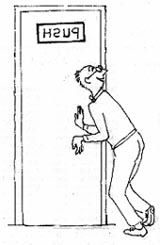
Look at these two pictures, read the two words and see the actions.
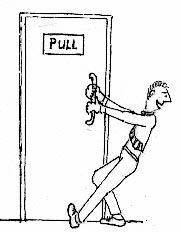
Pulling Pushing

Action words are called Verbs.

Push                   Pushing
Pull                     Pulling

The English verb has five forms to show the time of the action. They are:
1. Present
2. Past
3. Past participle
4. Present participle
5. Infinitive

In this course we name them as:

V1
V2
V3
V4
V5
Push Pushed Pushed Pushing (To) push
Pull Pulled Pulled Pulling (To) pull
Bathe Bathed Bathed Bathing (To) bathe
Open Opened Opened Opening (To) open
Draw Drew Drawn Drawing (To) draw
Break Broke Broken Breaking (To) break
Fall Fell Fallen Falling (To) fall

The first four verbs given in the above table are called REGULAR VERBS. You can remember them easily because V2 and V3 forms have ‘ED’ or ‘D’ and V4 has ‘ING’ at the end and V5 has ‘TO’ at the beginning. IRREGULAR VERBS have different forms for V2 and V3. Most common verbs we use every day are IRREGULAR VERBS. You have to learn about 200 such verbs by heart.

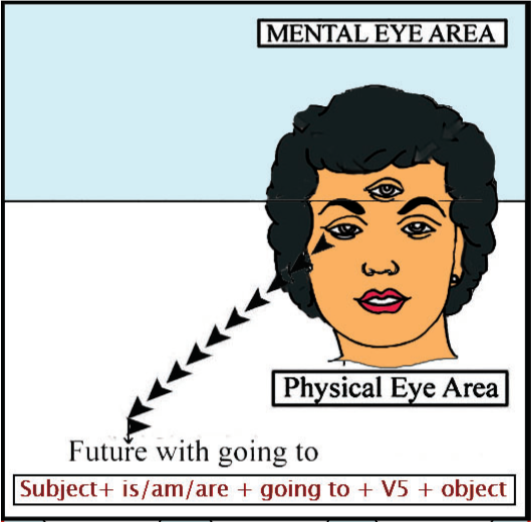
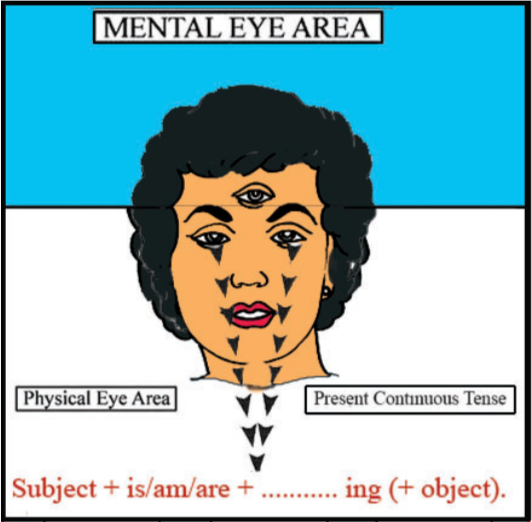
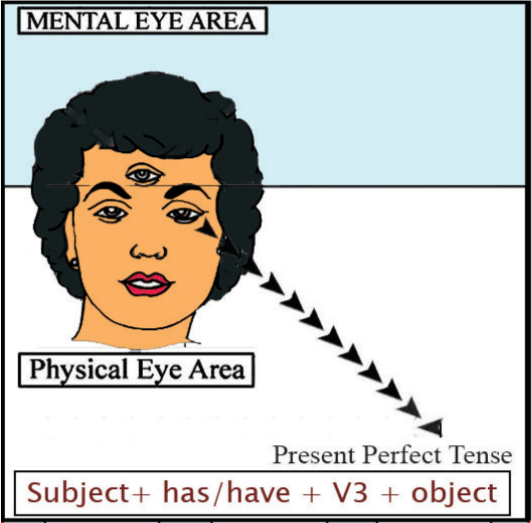
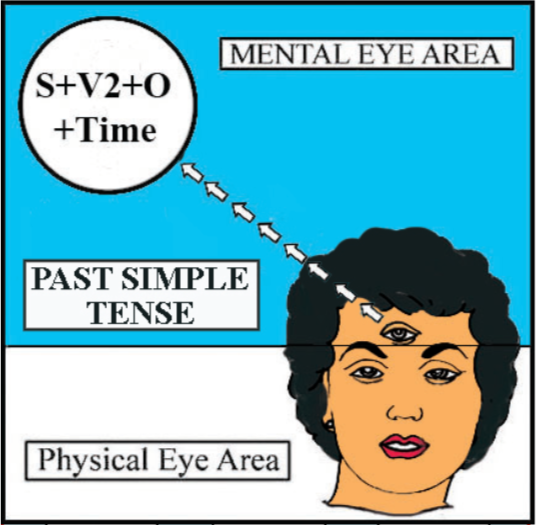
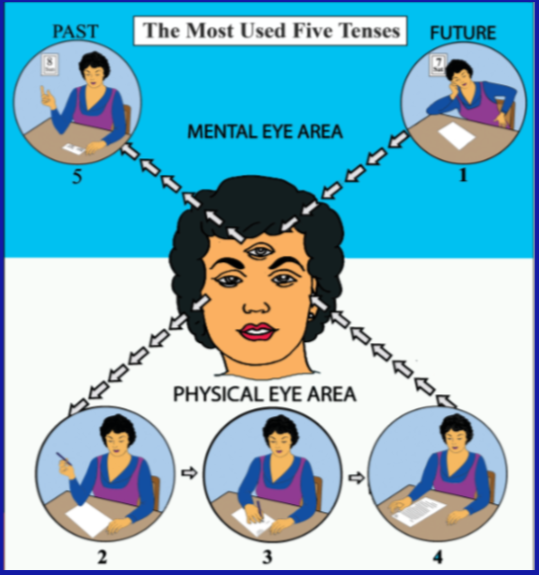
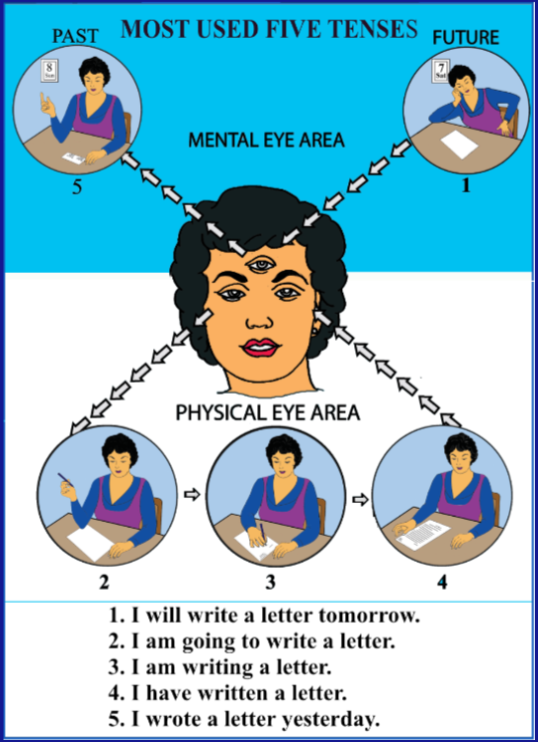
Now, you have some idea about these five forms of the English verb. These five forms help us to express THE TIME FACTOR in the language. We can see only three stages of an action with our eyes and all the other stages, that is, past experiences and future imaginations can be seen only with our mind’s eye.
Let’s examine what we see with our eyes and how we express what we see.
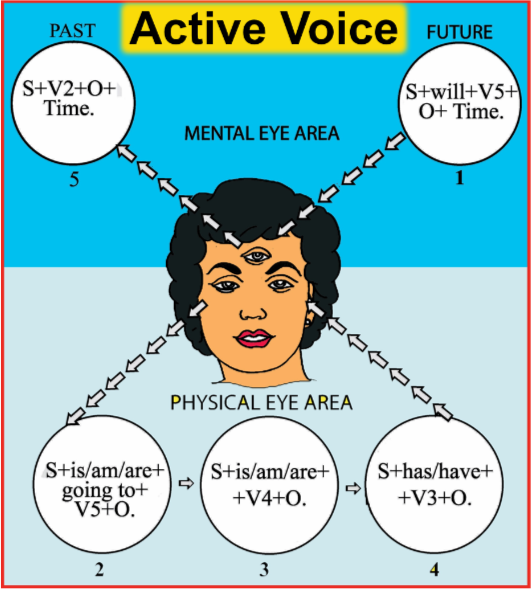
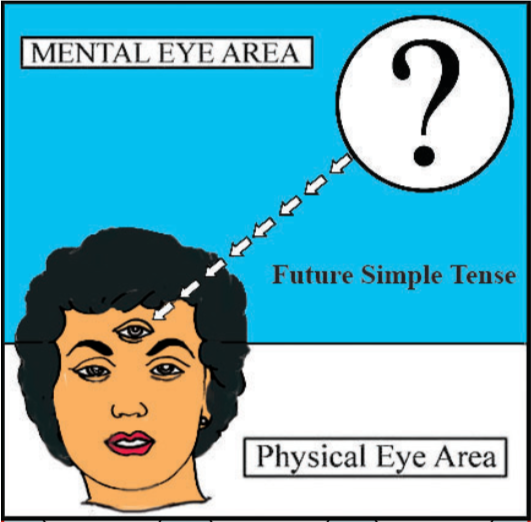
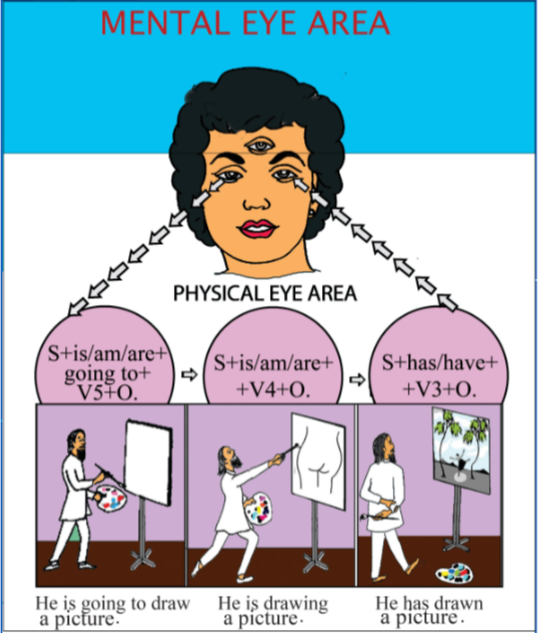
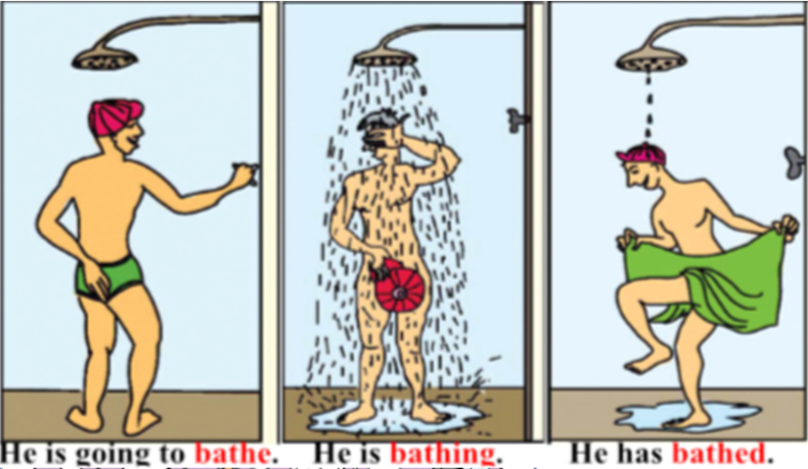
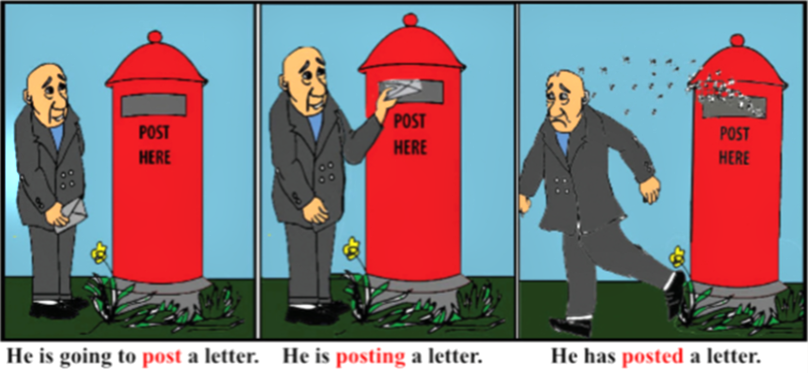
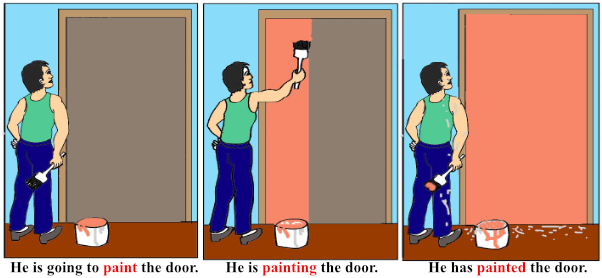
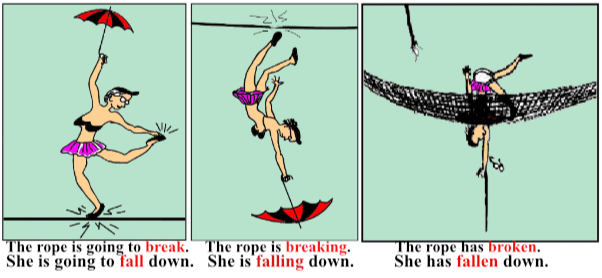
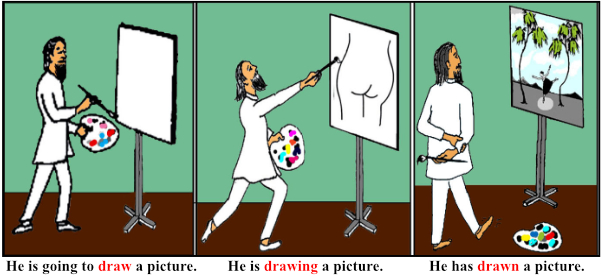
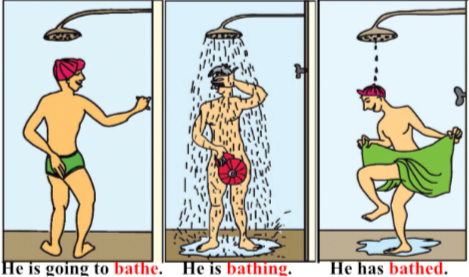
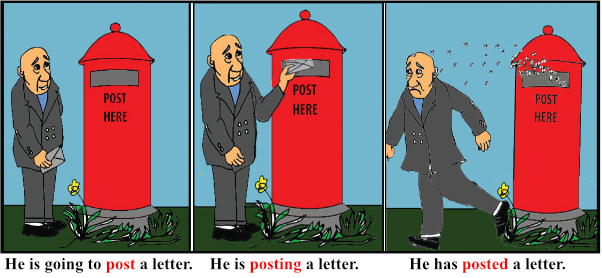
Active voice tense chart: a woman's mental and physical eye areas linking five tense patternsWoman's face with a question mark in the mental eye area for the future simple tenseWoman's face with arrows for the future with going to: subject + is/am/are + going to + V5Woman's face with arrows for the present continuous: subject + is/am/are + ingWoman's face with arrows for the present perfect: subject + has/have + V3 + objectWoman's face looking back to the past simple tense: S + V2 + O + time"The Most Used Five Tenses" chart with a woman writing a letter at each stageFive tenses chart with a woman writing: "I am going to write a letter. I have written a letter."Mental eye area chart with an artist: "He is going to draw", "He is drawing", "He has drawn a picture"Three panels: "He is going to open the bottle", "He is opening", "He has opened the bottle"Three panels: "He is going to paint the door", "He is painting", "He has painted the door"Tightrope walker panels: "The rope is going to break. She is falling down. She has fallen down."Artist panels: "He is going to draw a picture", "He is drawing", "He has drawn a picture"Shower panels: "He is going to bathe. He is bathing. He has bathed."Man at a red post box: "He is going to post a letter", "He is posting", "He has posted"

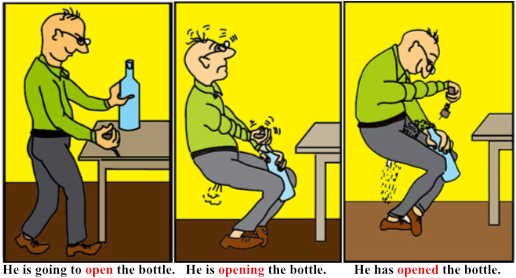
We can see only three aspects of an action with our Physical Eye. See the following examples.
STAGE 1
Ready to begin an action. You can guess the action about to take place.

STAGE 2
Action continuing. You see what is happening.

STAGE 3
Action completed. You see only the result of the action but not the action.


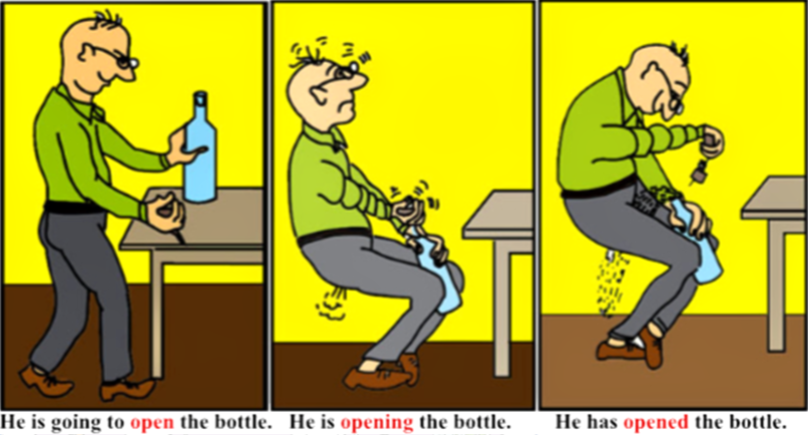
Look at these pictures carefully and read the sentences given.Three panels: "He is going to open the bottle", "He is opening", "He has opened the bottle"
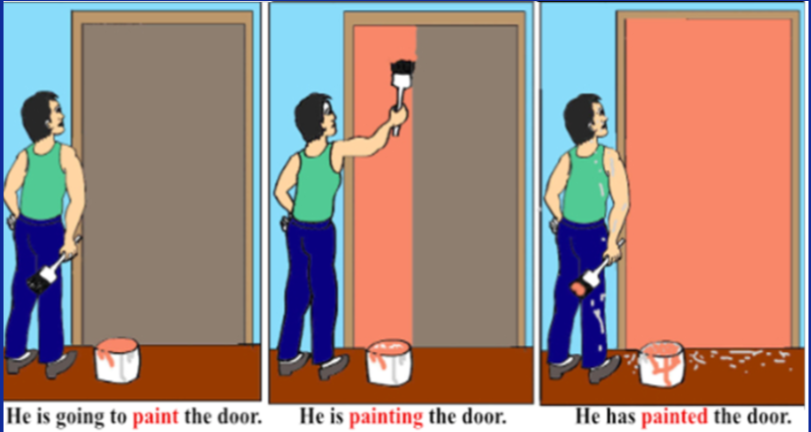
Three panels: "He is going to paint the door", "He is painting", "He has painted the door"

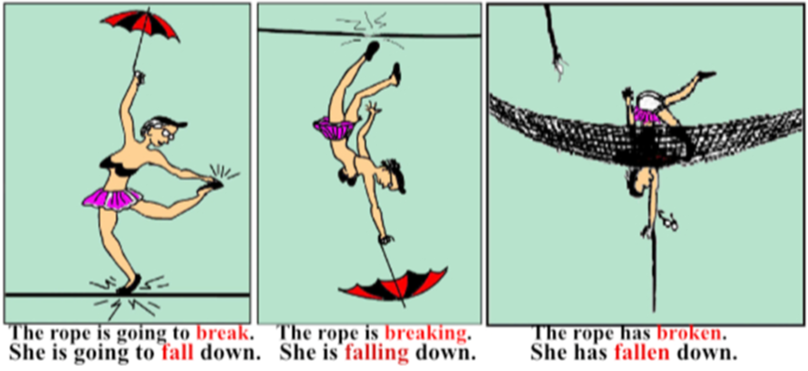
Tightrope walker panels: "The rope is going to break", "The rope is breaking", "She has fallen down"Three sentences: "The rope is going to break. The rope is breaking. The rope has broken."

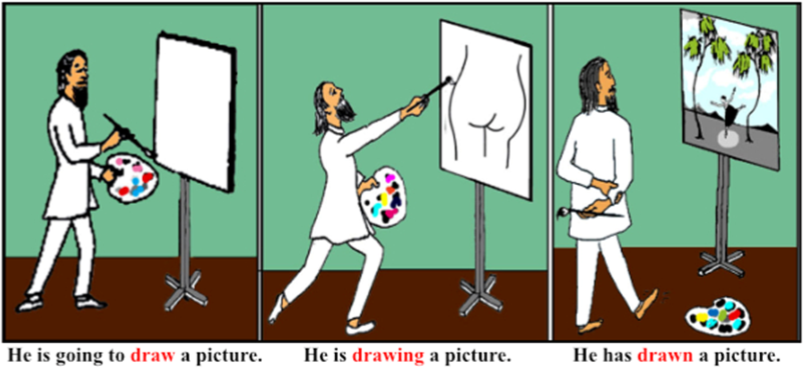
Artist panels: "He is going to draw a picture", "He is drawing", "He has drawn a picture"Shower panels: "He is going to bathe. He is bathing. He has bathed."

Man at a red post box: "He is going to post a letter", "He is posting", "He has posted"


Practice:

Naming the parts of a doll.

First name the parts of this doll
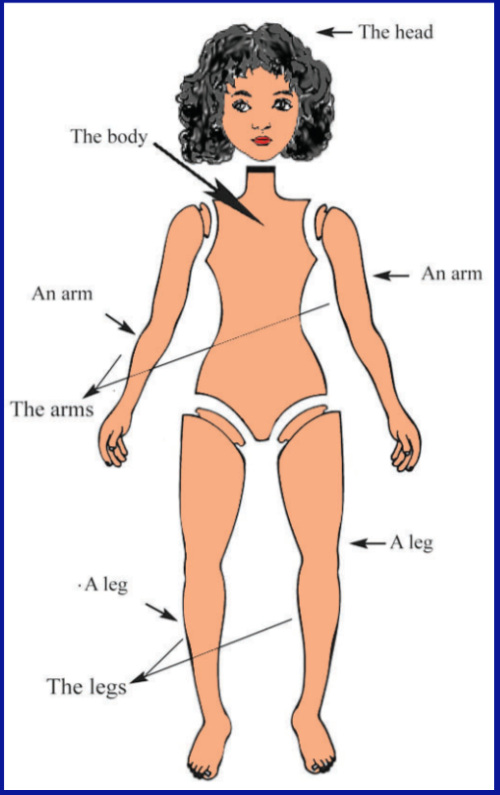
Paper doll with labelled parts: the head, the body, an arm, the arms, a leg, the legs


Making the parts of a doll.

Step 1. Get some clay. Take a small piece to make the head. Keep it on the tip of your index finger and say:
I’m going to make the head.

Step 2. Place the piece of clay on your palm and roll it with the other palm and say:
I’m making the head.

Step 3. Place the ball you have made on the table and say:
I have made the head.

Follow the above steps and make the other parts of your doll.
Practice these sentences while making the parts of your doll :

I’m going to make the body.
I’m making the body.
I’ve made the body.

I’m going to make an arm.
I’m making an arm.
I’ve made an arm.

I’m going to make the other arm.
I’m making the other arm.
I’ve made the other arm.

I’m going to make a leg.
I’m making a leg.
I’ve made a leg.

I’m going to make the other leg.
I’m making the other leg.
I’ve made the other leg.

I’ve made all parts of the doll.


Fixing the parts of your doll.

Take the head to your right hand and take the body to your left hand and say:
I’m going to fix the head to the body.
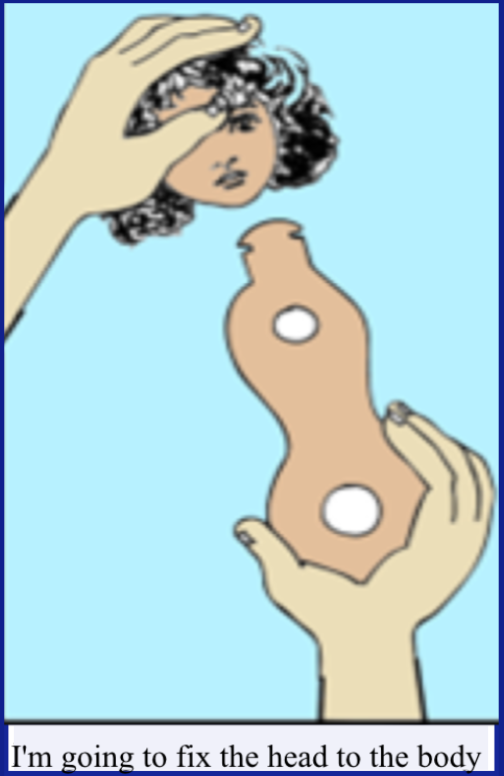
Hands holding a doll's head and body: "I'm going to fix the head to the body"

While fixing say:
I’m fixing the head to the body.
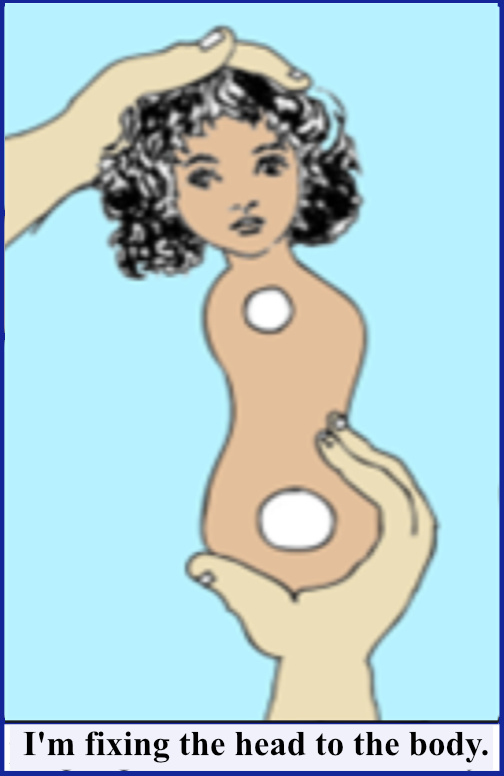
Hands pressing a doll's head onto its body: "I'm fixing the head to the body."

After fixing say:
I’ve fixed the head to the body.
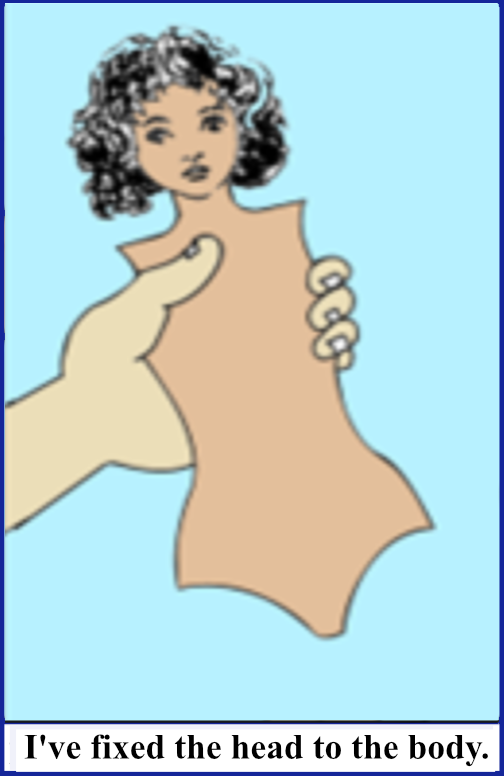
Hand holding a doll with its head on: "I've fixed the head to the body."

Practice fixing the other parts like this:

I’m going to fix an arm to the body.
I’m fixing an arm to the body.
I’ve fixed an arm to the body.

I’m going to fix the other arm to the body.
I’m fixing the other arm to the body.
I’ve fixed the other arm to the body.

I’m going to fix a leg to the body.
I’m fixing a leg to the body.
I’ve fixed a leg to the body.

I’m going to fix the other leg to the body.
I’m fixing the other leg to the body.
I’ve fixed the other leg to the body.
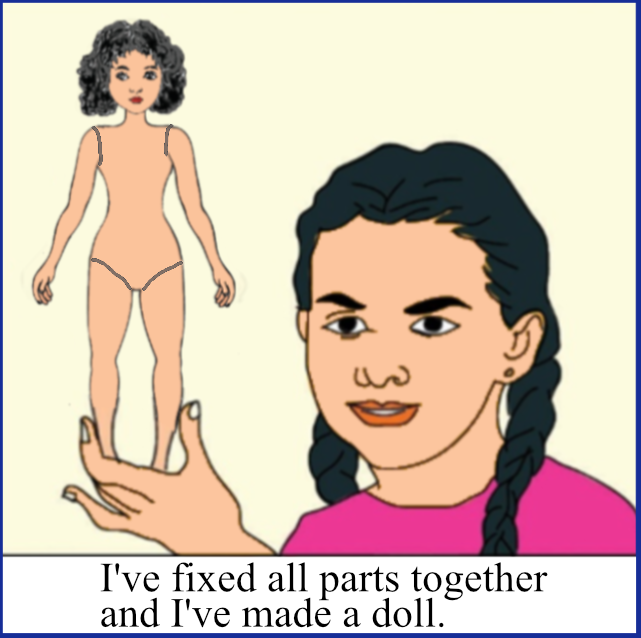
Girl holding a finished paper doll: "I've fixed all parts together and I've made a doll."


I’ve fixed all parts together and I’ve made a doll.

*** Practice making a doll at least 10 times.

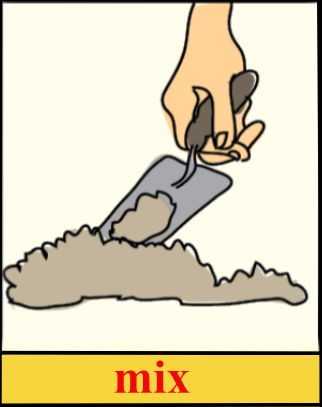
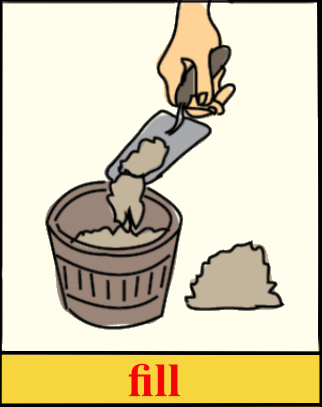
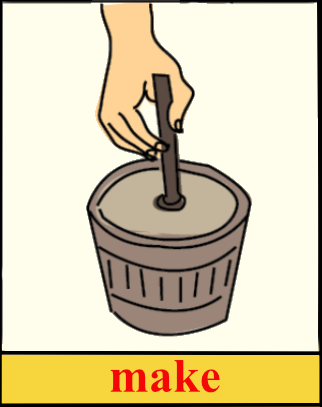
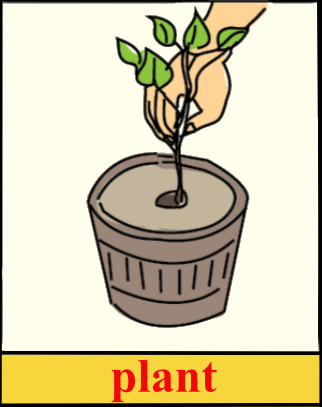
Now practice planting a rose cutting.
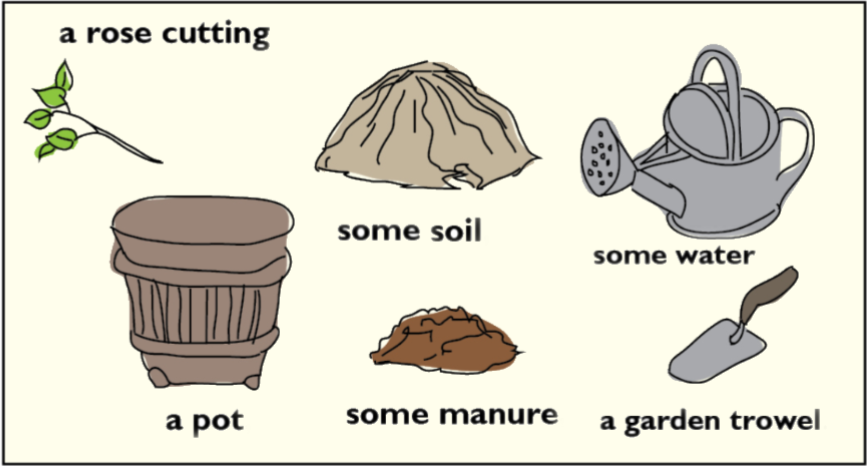
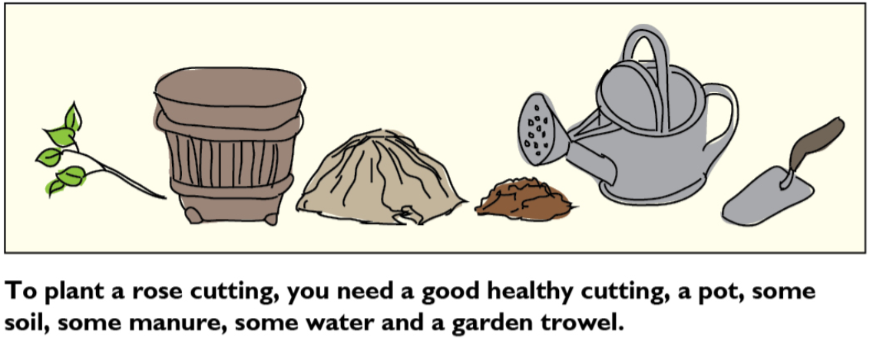
Things for planting: a rose cutting, a pot, some soil, some manure, some water, a garden trowel

Rose cutting, pot, soil, manure, watering can and trowel needed to plant a rose cuttingHand mixing soil with a garden trowel, labelled "mix"

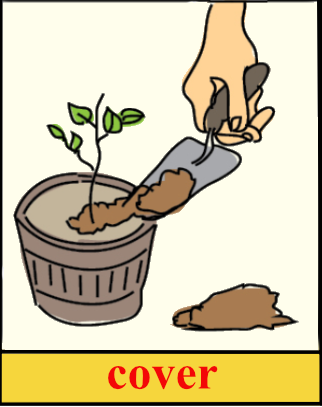
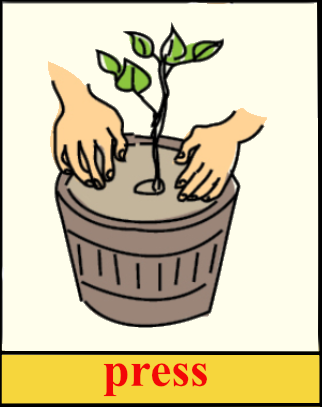
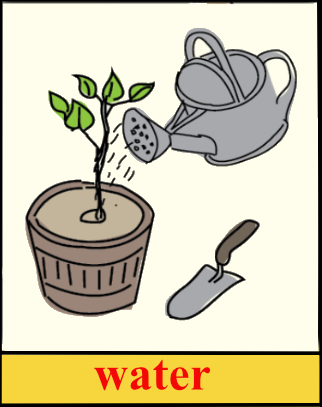
Hand filling a pot with soil using a trowel, labelled "fill"Hand making a hole in the soil of a pot with a stick, labelled "make"Hand planting a rose cutting in a pot, labelled "plant"Hand covering the cutting with manure using a trowel, labelled "cover"Hands pressing the soil around the cutting, labelled "press"Watering can watering the potted cutting, labelled "water"

The sentence patterns are as follows:
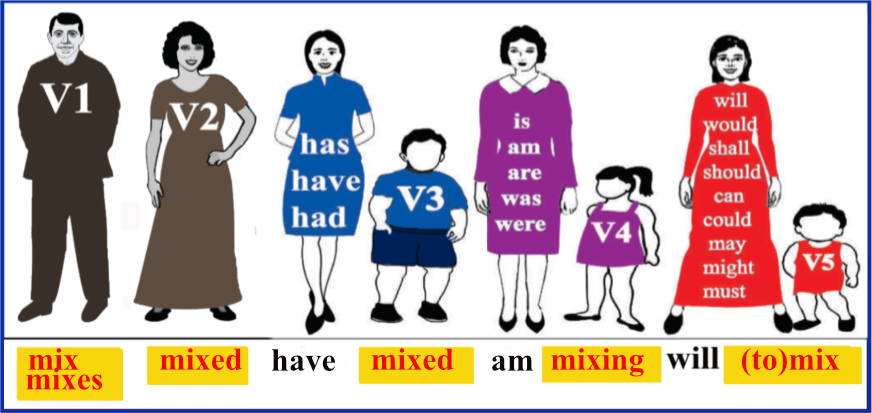
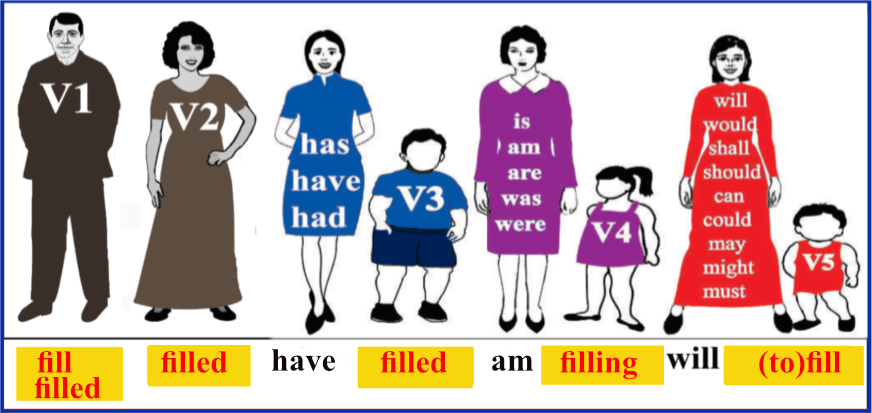
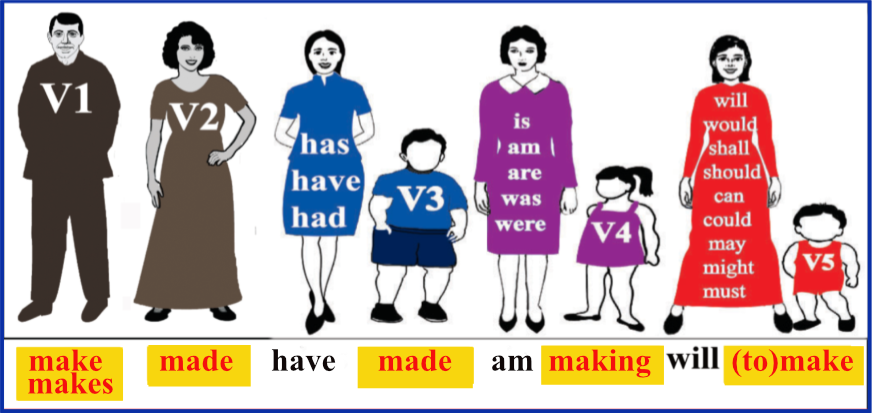
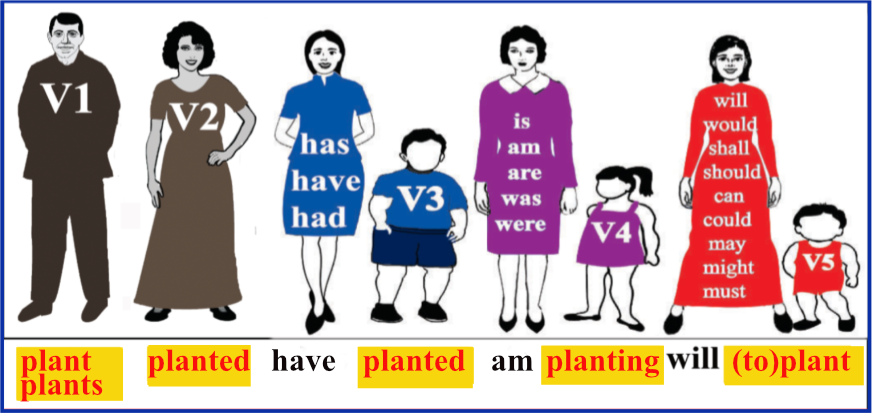
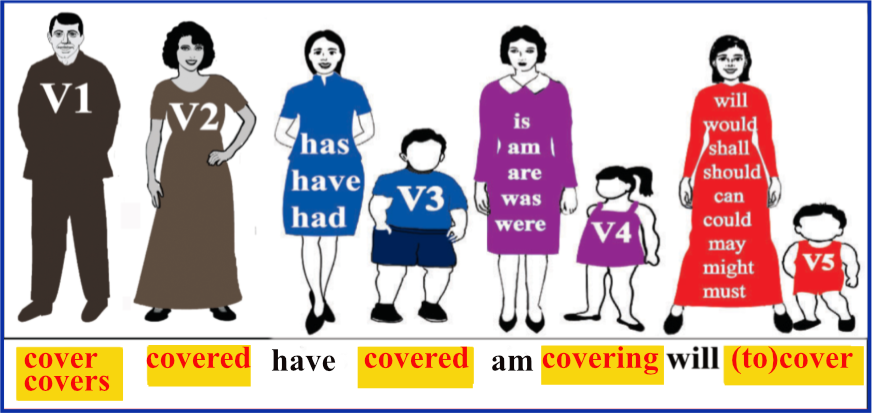
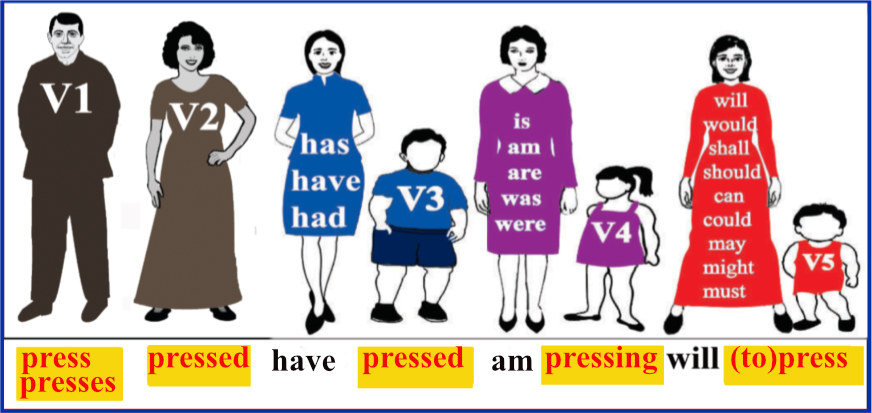
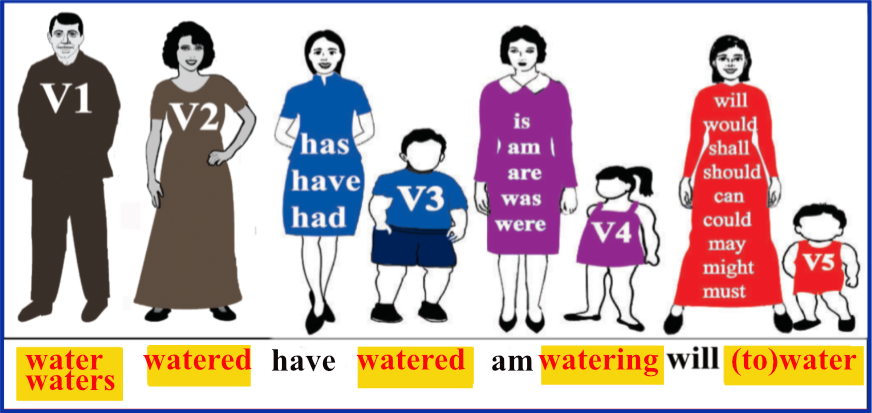
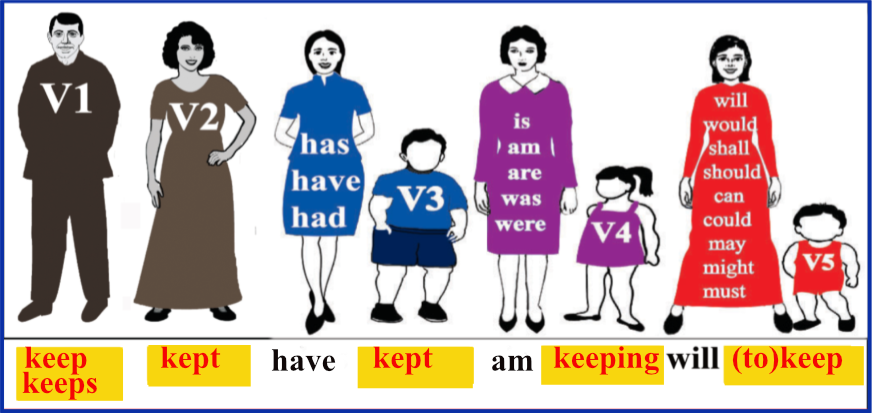
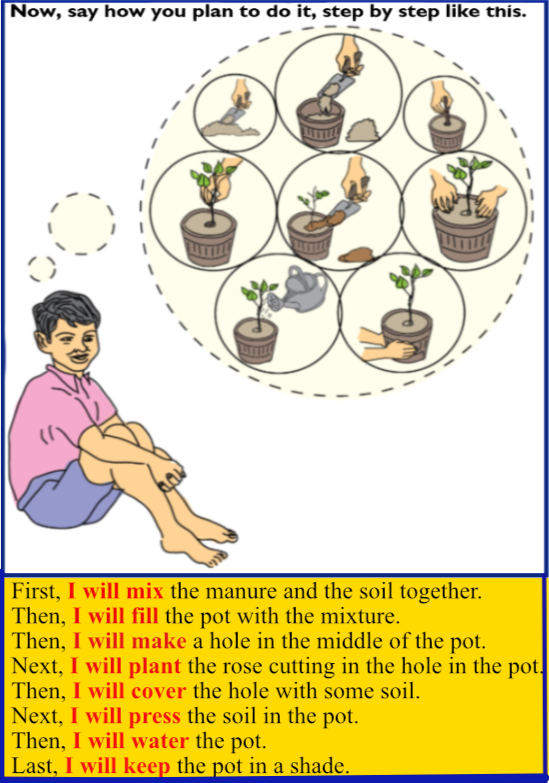
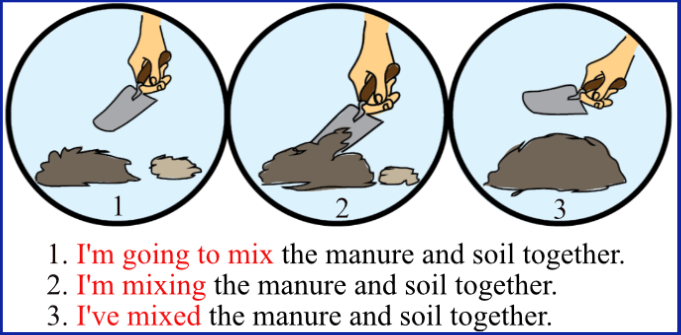
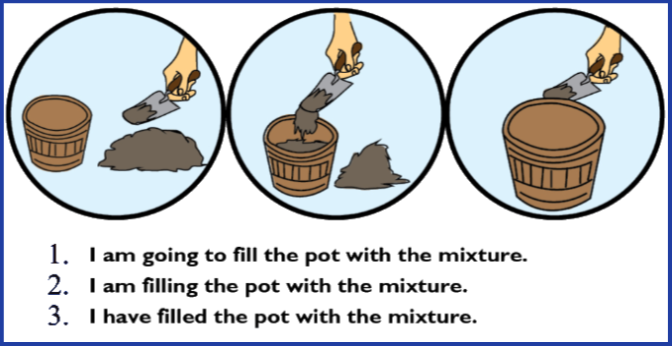
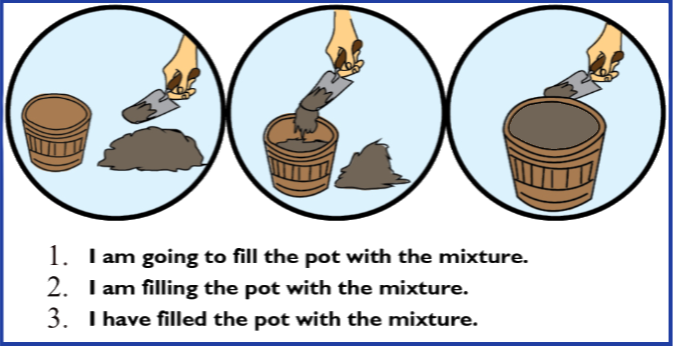
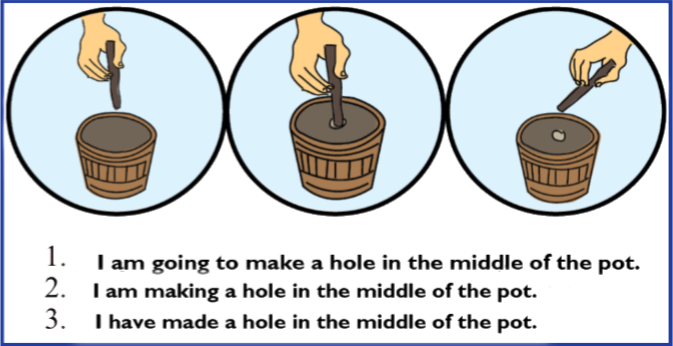
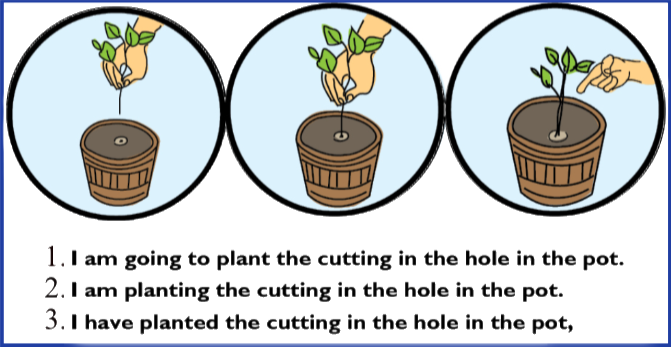
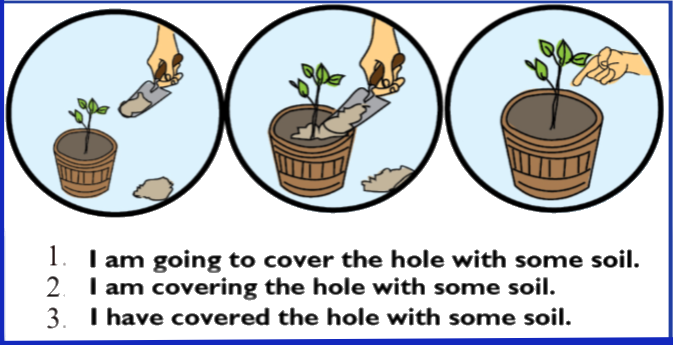
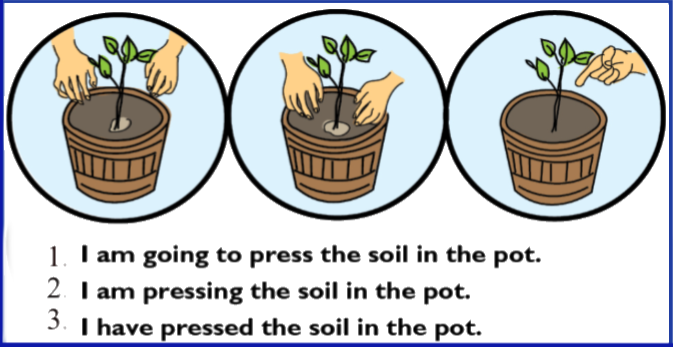
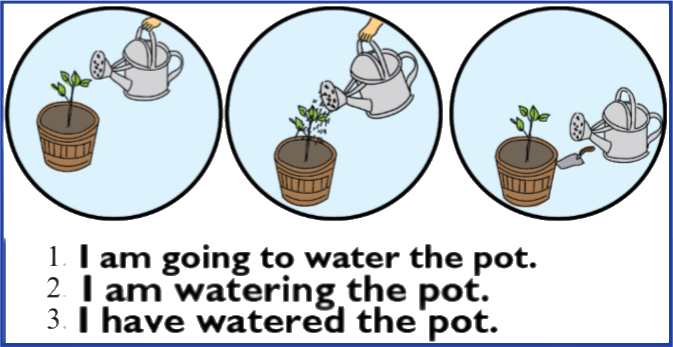
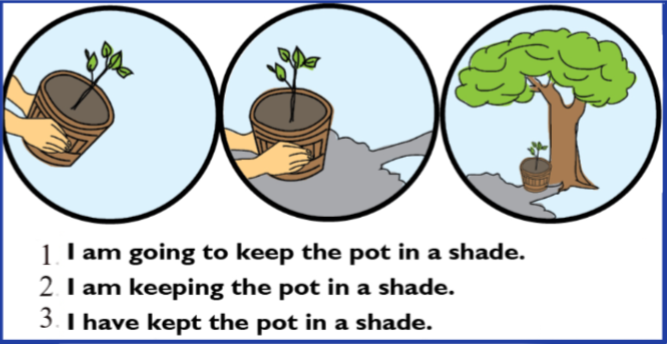
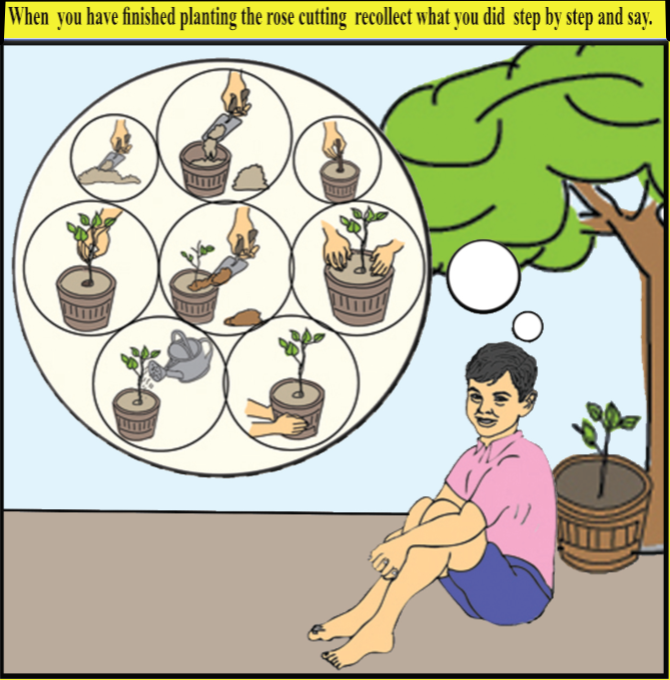
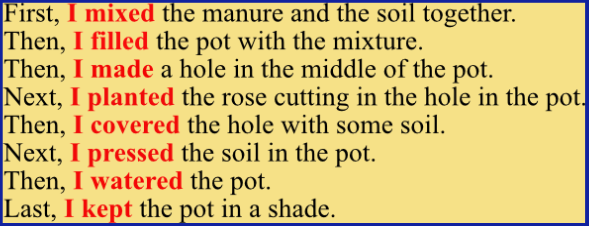
Verb family figures V1 to V5 for mix: mix, mixed, have mixed, am mixing, will mixVerb family figures V1 to V5 for fill: fill, filled, have filled, am filling, will fillVerb family figures V1 to V5 for make: make, made, have made, am making, will makeVerb family figures V1 to V5 for plant: plant, planted, have planted, am planting, will plantVerb family figures V1 to V5 for cover: cover, covered, have covered, am covering, will coverVerb family figures V1 to V5 for press: press, pressed, have pressed, am pressing, will pressVerb family figures V1 to V5 for water: water, watered, have watered, am watering, will waterVerb family figures V1 to V5 for keep: keep, kept, have kept, am keeping, will keepBoy imagining the planting steps: "First, I will mix the manure and the soil together."Three circles of mixing soil: "I'm going to mix", "I'm mixing", "I've mixed the manure and soil"Three circles of filling a pot: "I am going to fill the pot with the mixture."Three circles of filling a pot: "I am filling the pot", "I have filled the pot with the mixture."Three circles of making a hole: "I am going to make a hole in the middle of the pot."Three circles of planting: "I am going to plant the cutting in the hole in the pot."Three circles of covering: "I am going to cover the hole with some soil."Three circles of pressing: "I am going to press the soil in the pot."Three circles of watering: "I am going to water the pot. I have watered the pot."Three circles of moving the pot under a tree: "I am going to keep the pot in a shade."Boy by a potted plant recalling each planting step in a thought bubblePast tense steps: "First, I mixed the manure and the soil together." Last, "I kept the pot in a shade."


Notes:

Take any action you know and make sentences using the above three patterns. Watch people at work and see how you can use the patterns you have already learnt.

Amarasiri Ganewatta

Amarasiri Ganewatta

Director, English Language Laboratory

Amarasiri Ganewatta is the director of the English Language Laboratory. He is a retired English teacher and a language translator living in California, USA.

Email: ganewatta@gmail.com

Books by the Author

Understanding Advanced English Grammar 1 in 3D by Amarasiri Ganewatta, book cover

‘UNDERSTANDING ADVANCED ENGLISH GRAMMAR’ is the first book of a series of three books. This book begins with the introduction of the three dimensions of the English language. It is an innovative method of teaching Active Voice, Passive Voice and Causative uses looking at an action in three different angles.

Available at Amazon
English Interrogatives by Amarasiri Ganewatta, book cover

ENGLISH INTERROGATIVES

Interrogative words may be used in direct questions as well as in indirect questions. They are also used as Relative Adverbs and Relative Pronouns. Therefore, we must have a clear understanding of how to use these very important ‘Wh’ words in English. This book covers all the important usages of interrogatives for the benefit of all users.

English Through Pictures by Amarasiri Ganewatta, book cover

It is clearly shown how the verbs ‘Be’, ‘Have’ and ‘Auxiliary Verbs’ control the flow of time in the English language. All these subtle things can never be grasped by a simple explanation with words. Therefore, the ‘ENGLISH through PICTURES’ book has so many illustrations drawn to give the finer points that all users of English should know.

Exploring Grammar World 1 by Amarasiri Ganewatta, book cover

EXPLORING GRAMMAR WORLD 1      The verb illustrated in the book as a family of five (father, mother and three little children) is one creative idea which will help to solve the grammar problems about the behaviour of the verb.

‘EXPLORING GRAMMAR WORLD 1’is the first book of a series of books. The author of this book has been teaching languages for nearly five decades to learners of all ages, from primary and secondary to higher education and even to elderly people. The experience gathered in teaching helps the author in developing a new method of teaching language.
          Grammar is like the skeleton of the human body. If there is any deformation in any part of the skeleton, the others will immediately notice it. In the same manner, if ever you make any grammatical mistakes, your audience will notice it. That is why learning grammar is highly important as a language skill.
   

Exploring Grammar World 2 by Amarasiri Ganewatta, book cover

 ‘EXPLORING GRAMMAR WORLD 2’teaches you how to ask and answer all types of questions.
A successful life flourishes on the never-ending drive to understand the ‘Why’ and ‘How’. This urge leads to continuous learning and reshapes how we live, work, learn and engage in day-to-day affairs. This book ‘EXPLORING GRAMMAR WORLD 2’ will fulfil your desire.

Exploring Grammar World 3 by Amarasiri Ganewatta, book cover

‘EXPLORING GRAMMAR WORLD 3’ brings you the most important English sentence patterns. In the first chapter of the book, two Idiomatic expressions, ‘There is/ are, and It is/was/ had been/ will be’ are given with many examples.  Chapter two in the book opens a new door to the conditional world. Conditional Clauses (If clauses) can be put into four categories as 1. Possible Conditions, 2. Probable Conditions, 3. Impossible Conditions, and 4. Zero Condition. There are other conditional sentence patterns too, for expressing Imaginary and Unreal situations. All these Conditional Sentence Patterns are given with examples and illustrations which will help you to remember them easily. For your guidance, relevant exercises are also included. You will find the Answer key at the end of the book.

Five Funniest Stories by Amarasiri Ganewatta, book cover

The stories in this book are full of funny imaginary dialogues, helping the readers to improve their ability to use fun in their day-to-day conversation and are beneficial for developing language skills. Another benefit is that they help readers understand the importance of basic moral values such as politeness, kindness, generosity, and sympathy.

Great Grammar Guide by Amarasiri Ganewatta, book cover

This book contains all the grammar rules, usages, sentence patterns of active voice, passive voice, and causative, English sound system, numbers and counting, nouns, gerunds, prepositions, adjectives, reported speech, word order in sentences, accepted phrases, homophones, phrasal verbs, essay writing, punctuation, English for day-to-day activities, language exercises and an answer key to the exercises.

Know-How English Grammar by Amarasiri Ganewatta, book cover

All the grammar rules are filters used before our eyes and ears for purifying the language we hear and see. The more filters you have, the better knowledge and ability you have to see and read the world as it is. This book provides you with the finest filters you wish to have, giving you the best grammar knowledge.

Revolutionize Learning Grammar by Amarasiri Ganewatta, book cover

‘REVOLUTIONIZE LEARNING GRAMMAR’ is a book which shows how all the Active Voice, Passive Voice and Causative tenses are used in English. We acquire the ability in our childhood to use language to communicate through a set of sounds, gestures, or written words and learn to convey messages, ideas, feelings, and emotions to people who use the same language. If you know the basic grammar rules of your first language, it is quite easy to learn English grammar by using this book because it is the only grammar book which shows the three dimensions of language, helping you to read the world as you see. This book will definitely revolutionise your learning English.

Time and Tenses: The Fourth Dimension by Amarasiri Ganewatta, book cover

There are 44 sentence patterns in English to show the flow of time in the three dimensions: Active Voice, Passive Voice, and Causative. The relevant sentence patterns are given with many examples and illustrations so that anyone who uses this book will be able to convey all subtle feelings and desires using English without any confusion. This book has been written after many years of observation, analysis, and research using several methods and hundreds of illustrations to present how time and tense work in the English language.

44 English Phonics by Amarasiri Ganewatta, book cover

This book provides help for beginners to improve their standard pronunciation greatly because it gives all the sounds of vowels and consonants with examples and relevant illustrations.

Perfect English Grammar in 3D by Amarasiri Ganewatta, book cover

The practice lessons given in this book with illustrations will help to solve all the grammar problems of the students who are learning English as a second language. This book provides you the knowledge necessary to master the three dimensions of English grammar.

English Grammar Through Pictures by Amarasiri Ganewatta, book cover

If you know the basic grammar rules of your first language, it is quite easy to learn English grammar by using this book because it is the only grammar book which shows the three dimensions of language with hundreds of lively illustrations helping you to read the world as you see. This book will definitely revolutionise your learning English.

Understanding Advanced English Grammar 1 in 3D Through Pictures by Amarasiri Ganewatta, book cover

Once you follow the lessons in this book, you will find that English grammar is easier than any other grammar.

Understanding Advanced English Grammar 2 in 3D Through Pictures by Amarasiri Ganewatta, book cover

There are sixteen active voice tense patterns in the English language, and all these patterns are given with examples and illustrations in this book. They will help solve all the grammar problems pertaining to the usage of English tenses.

Understanding Advanced English Grammar 3 in 3D Through Pictures by Amarasiri Ganewatta, book cover

   All the relevant sentence patterns with illustrations are given in this book so that readers can use English without any grammar difficulties. Appropriate exercises and Answer Keys will help you to test your grammar knowledge in the fields of Adverbs, Conditional Clauses, and Reported Speech.

Lazy Jack by Amarasiri Ganewatta, book cover

LAZY JACK is a book full of colourful illustrations and interesting dialogues suitable for young children to motivate novel visions about life. The original story LAZY JACK was written by James Orchard Halliwell-Phillipps (1820 – 1889), who was a great literary figure and contributed much to English literature. By collecting traditional stories and nursery rhymes, he did a great service to the children of the world.

English Phrasal Verbs Through Pictures by Amarasiri Ganewatta, book cover

ENGLISH PHRASAL VERBS THROUGH PICTURES is a book with a new vision. Phrasal verbs are very useful for expressing one’s feelings with emotions.  The English language is rich with many phrasal verbs that are constantly used in everyday communication. The learners will be able to keep all the phrasal verbs in mind as visuals and forget about the words and sentences; just try to remember the illustrations given. Close your eyes, and the words and sentences will appear in no time. Emotions cannot be seen but felt.  ENGLISH PHRASAL VERBS THROUGH PICTURES will help you to express your emotions colourfully.