Lesson 12 Food Preparation

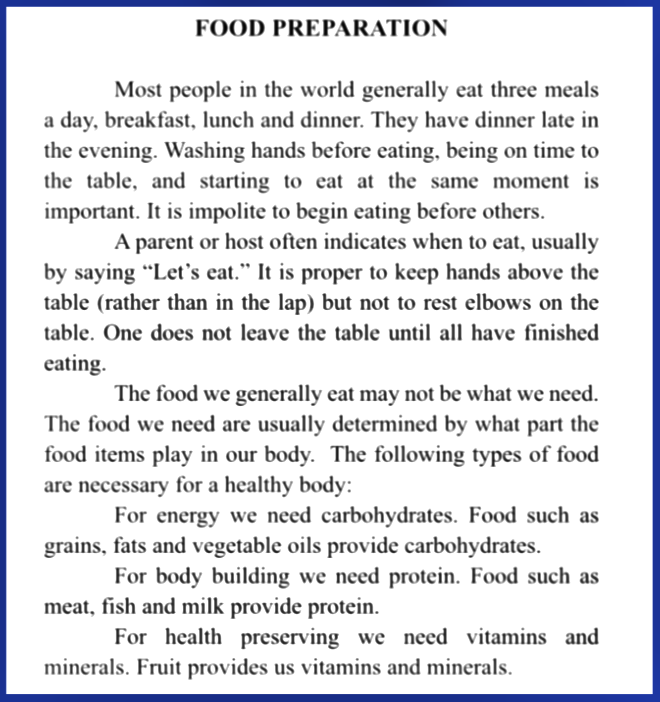
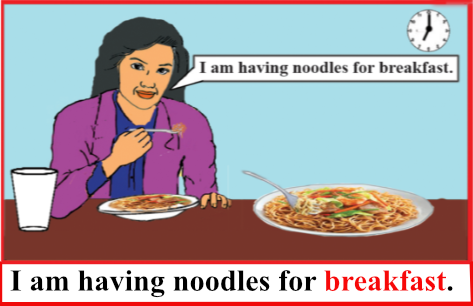
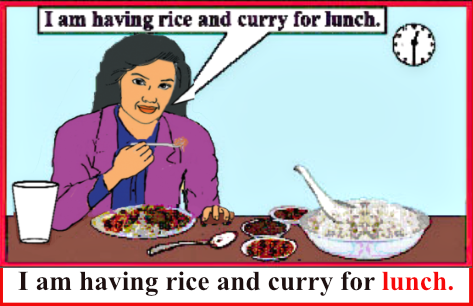
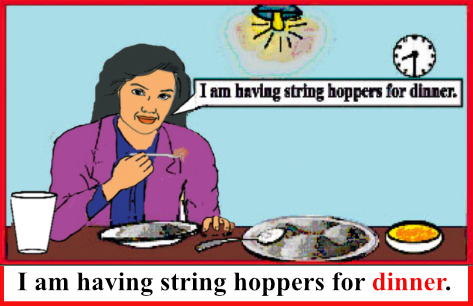
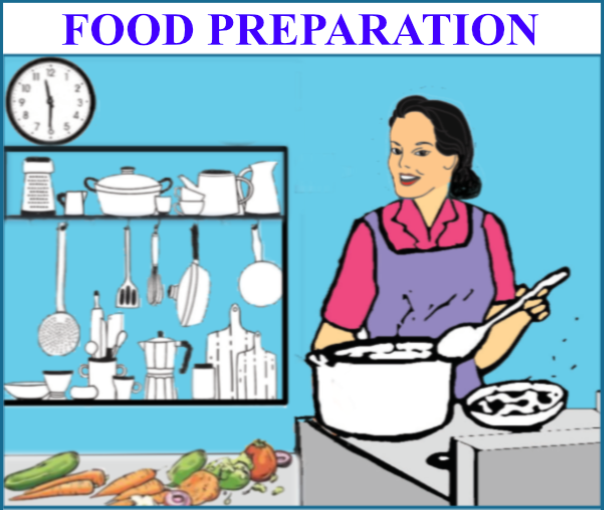
Text panel on food preparation: three daily meals, table manners and the food a healthy body needsWoman eating at a table by a clock: "I am having noodles for breakfast."Woman eating at a table: "I am having rice and curry for lunch."Woman eating under a lamp: "I am having string hoppers for dinner.""Food Preparation": woman stirring a pot in a kitchen with utensils on shelves and vegetables


Words related to cooking.


BAKE

To cook by dry heat in oven.


BATTER

Any mixture of dry ingredients such as flour and liquids that is stirred or beaten and can be poured.


BIND

Add a liquid, egg or melted fat to a dry mixture to hold it together.


BLANCH

To put food in boiling water in order to either whiten or remove the skin.


BLEND

To combine all ingredients thoroughly until very smooth or uniform.


BOIL

To cook at boiling point.


BROWNING

To put a cooked dish or meringue under the grill or in the oven for a short time to give a golden color.


CREAMING

Softening fat by friction with a spoon, usually followed by gradual incorporation of sugar.


CUTTING

It is reduced to small pieces by means of a knife.


CHOPPING

When a similar result is obtained with a chopper knife


DICING

Cutting into cubes


FILTRATION

Separating solids from liquids through fine meshed materials.


GRINDING

Reducing into small fragments by crushing as in grinding spices, as in coffee in a mill or in a grinding stone.


MARINATE

To soak food in liquid (e.g., lemon juice or lime juice or vinegar) that will flavor it.


MASHING

This is a method of breaking up soft foods with pressure with the aid of a masher, fork, or hands.


MINCING

Cutting into very fine pieces.


PARING

Paring is the removing of surface layer in a circular motion.


PEELING

The skin of vegetables such as potatoes or fruits is either peeled or scraped.


PRESSING

Separating liquid portions from solids.


REFINING

Freeing any material from impurities.


SAUTE

To fry foods in a small amount of fat until golden and tender.


SEIVING

Passing through a fine wire mesh to remove impurities. It also helps in mixing ingredients evenly.


SHREDDING

Cutting into long narrow pieces by means of a shredder or a knife.


SIFT

To pass through a fine sieve to remove lumps.


SKIMMING

Removing a floating layer


SLICING

Cutting into thin pieces


STEAM

To cook in the steam which arises from a pan of boiling water.


STEW

To cook slowly in a small amount of liquid for a long time.


STIRRING

Mixing materials with appropriate tools such as by a spoon in circular motion.


WASHING

Washing is necessary to remove superficial dirt from vegetables, meat, fish, and fruits.


WHIP

To beat rapidly to produce expansion through the incorporation of air, as in egg whites.


HOPPERS


Hoppers which are usually consumed either for breakfast or dinner are unique to Sri Lanka. There are many types of hoppers: plain hoppers, egg hoppers, and sweeter varieties.

Hoppers are made from a fermented batter of rice flour, coconut milk and a dash of yeast. Yeast or toddy is added for fermentation which makes the centers full of little holes. After leaving to rise, the batter is swirled in a pan. A hopper, crisp on the outside, but soft and spongy in the center, is best eaten with curries and sambals while still streaming hot.

Egg hoppers are made of the usual hopper where an egg is poached into its center. Honey hoppers too are delicacies enjoyed by both locals and foreigners.

Ingredients for making about 20 hoppers.


1 teaspoon dried yeast

1/2 cup warm water

1 1/2 teaspoons sugar

1 1/2 cups medium-coarse ground rice

1 1/2 cups fine rice flour

2 teaspoons salt

400 ml coconut milk

2 cups water


Sprinkle yeast over warm water, stir to dissolve, add sugar, and leave for 10 minutes or so.

Put ground rice, rice flour and salt into a large bowl. Add 300 ml coconut milk with Sprinkle yeast over warm water, stir to dissolved water and add yeast mixture.

Stir into dry ingredients to form a smooth, thick batter. Allow to stand overnight until the mixture rises and froths.

The batter should be of a thick pouring consistency, but thin enough to cover the sides of the pan with an almost transparent coating when the batter is swirled. It will be necessary to add extra water when the mixture is too thick.

Heat the pan over low heat until very hot. Rub the inside surface with a piece of folded cotton cloth dipped in coconut oil. Pour in a small ladle of the batter.

pick up the pan by both handles immediately.

Swirl it around so that the batter coats the pan two-thirds of the way up.

Cover the pan with a lid and cook on very low heat for about 5 minutes.

Lift the lid and peep. When the upper edges begin to turn a pale toasty color, the hopper is ready. Where the batter has run down the sides to the center there will be a little circle of spongy mixture, while the curved edge is very thin and crisp. With a metal spatula, loosen edges and slip the hopper from the pan onto a plate. Wipe pan again with oiled folded cloth and repeat.


Serve the hoppers warm, with hot chili, Maldive fish and onion sambal or any kind of curry.
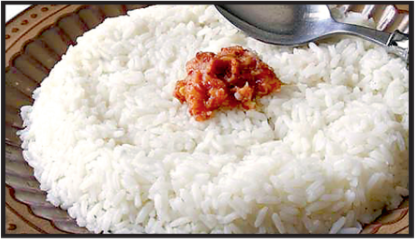
Plate of white rice topped with a red relish, with a spoon

How to make Kiri Bath (milk rice)

Ingredients

Brown rice or white rice

salt

water

Coconut milk (may use cow`s milk instead)

Steps

Wash the rice.

Put into a medium-sized pot.

Add the water and salt.

Cook the rice over medium-low heat.

When half of the water is evaporated, add the coconut milk.

Continue cooking for another ten minutes.

Remove the pot from the hearth.

Spread the milk rice on a tray or a board so it is two inch thick.

Level the mixture well by using a cleaned banana leaf.

Cut into squares with a knife.

Serve with Chilly sambal.

Lunu Miris (Chili sambal)

Ingredients

2 oz dry red chili pcs/flakes

1/2 oz Maldives fish (dry ground fish)

Lime juice

salt

2 oz onions

Grind all ingredients to a coarse paste.

Add salt and lime to taste.


Amarasiri Ganewatta

Amarasiri Ganewatta

Director, English Language Laboratory

Amarasiri Ganewatta is the director of the English Language Laboratory. He is a retired English teacher and a language translator living in California, USA.

Email: ganewatta@gmail.com

Books by the Author

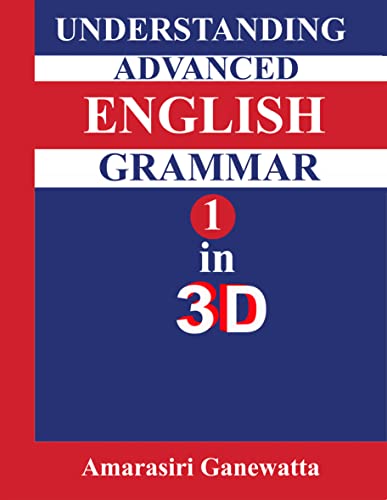
Understanding Advanced English Grammar 1 in 3D by Amarasiri Ganewatta, book cover

‘UNDERSTANDING ADVANCED ENGLISH GRAMMAR’ is the first book of a series of three books. This book begins with the introduction of the three dimensions of the English language. It is an innovative method of teaching Active Voice, Passive Voice and Causative uses looking at an action in three different angles.

Available at Amazon
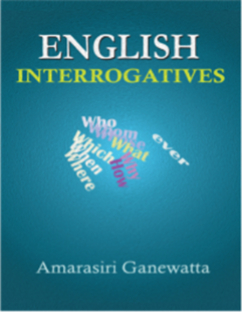
English Interrogatives by Amarasiri Ganewatta, book cover

ENGLISH INTERROGATIVES

Interrogative words may be used in direct questions as well as in indirect questions. They are also used as Relative Adverbs and Relative Pronouns. Therefore, we must have a clear understanding of how to use these very important ‘Wh’ words in English. This book covers all the important usages of interrogatives for the benefit of all users.

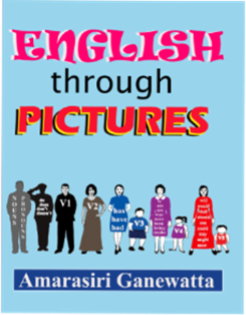
English Through Pictures by Amarasiri Ganewatta, book cover

It is clearly shown how the verbs ‘Be’, ‘Have’ and ‘Auxiliary Verbs’ control the flow of time in the English language. All these subtle things can never be grasped by a simple explanation with words. Therefore, the ‘ENGLISH through PICTURES’ book has so many illustrations drawn to give the finer points that all users of English should know.

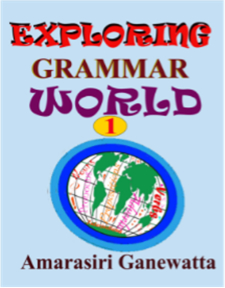
Exploring Grammar World 1 by Amarasiri Ganewatta, book cover

EXPLORING GRAMMAR WORLD 1      The verb illustrated in the book as a family of five (father, mother and three little children) is one creative idea which will help to solve the grammar problems about the behaviour of the verb.

‘EXPLORING GRAMMAR WORLD 1’is the first book of a series of books. The author of this book has been teaching languages for nearly five decades to learners of all ages, from primary and secondary to higher education and even to elderly people. The experience gathered in teaching helps the author in developing a new method of teaching language.
          Grammar is like the skeleton of the human body. If there is any deformation in any part of the skeleton, the others will immediately notice it. In the same manner, if ever you make any grammatical mistakes, your audience will notice it. That is why learning grammar is highly important as a language skill.
   

Exploring Grammar World 2 by Amarasiri Ganewatta, book cover

 ‘EXPLORING GRAMMAR WORLD 2’teaches you how to ask and answer all types of questions.
A successful life flourishes on the never-ending drive to understand the ‘Why’ and ‘How’. This urge leads to continuous learning and reshapes how we live, work, learn and engage in day-to-day affairs. This book ‘EXPLORING GRAMMAR WORLD 2’ will fulfil your desire.

Exploring Grammar World 3 by Amarasiri Ganewatta, book cover

‘EXPLORING GRAMMAR WORLD 3’ brings you the most important English sentence patterns. In the first chapter of the book, two Idiomatic expressions, ‘There is/ are, and It is/was/ had been/ will be’ are given with many examples.  Chapter two in the book opens a new door to the conditional world. Conditional Clauses (If clauses) can be put into four categories as 1. Possible Conditions, 2. Probable Conditions, 3. Impossible Conditions, and 4. Zero Condition. There are other conditional sentence patterns too, for expressing Imaginary and Unreal situations. All these Conditional Sentence Patterns are given with examples and illustrations which will help you to remember them easily. For your guidance, relevant exercises are also included. You will find the Answer key at the end of the book.

Five Funniest Stories by Amarasiri Ganewatta, book cover

The stories in this book are full of funny imaginary dialogues, helping the readers to improve their ability to use fun in their day-to-day conversation and are beneficial for developing language skills. Another benefit is that they help readers understand the importance of basic moral values such as politeness, kindness, generosity, and sympathy.

Great Grammar Guide by Amarasiri Ganewatta, book cover

This book contains all the grammar rules, usages, sentence patterns of active voice, passive voice, and causative, English sound system, numbers and counting, nouns, gerunds, prepositions, adjectives, reported speech, word order in sentences, accepted phrases, homophones, phrasal verbs, essay writing, punctuation, English for day-to-day activities, language exercises and an answer key to the exercises.

Know-How English Grammar by Amarasiri Ganewatta, book cover

All the grammar rules are filters used before our eyes and ears for purifying the language we hear and see. The more filters you have, the better knowledge and ability you have to see and read the world as it is. This book provides you with the finest filters you wish to have, giving you the best grammar knowledge.

Revolutionize Learning Grammar by Amarasiri Ganewatta, book cover

‘REVOLUTIONIZE LEARNING GRAMMAR’ is a book which shows how all the Active Voice, Passive Voice and Causative tenses are used in English. We acquire the ability in our childhood to use language to communicate through a set of sounds, gestures, or written words and learn to convey messages, ideas, feelings, and emotions to people who use the same language. If you know the basic grammar rules of your first language, it is quite easy to learn English grammar by using this book because it is the only grammar book which shows the three dimensions of language, helping you to read the world as you see. This book will definitely revolutionise your learning English.

Time and Tenses: The Fourth Dimension by Amarasiri Ganewatta, book cover

There are 44 sentence patterns in English to show the flow of time in the three dimensions: Active Voice, Passive Voice, and Causative. The relevant sentence patterns are given with many examples and illustrations so that anyone who uses this book will be able to convey all subtle feelings and desires using English without any confusion. This book has been written after many years of observation, analysis, and research using several methods and hundreds of illustrations to present how time and tense work in the English language.

44 English Phonics by Amarasiri Ganewatta, book cover

This book provides help for beginners to improve their standard pronunciation greatly because it gives all the sounds of vowels and consonants with examples and relevant illustrations.

Perfect English Grammar in 3D by Amarasiri Ganewatta, book cover

The practice lessons given in this book with illustrations will help to solve all the grammar problems of the students who are learning English as a second language. This book provides you the knowledge necessary to master the three dimensions of English grammar.

English Grammar Through Pictures by Amarasiri Ganewatta, book cover

If you know the basic grammar rules of your first language, it is quite easy to learn English grammar by using this book because it is the only grammar book which shows the three dimensions of language with hundreds of lively illustrations helping you to read the world as you see. This book will definitely revolutionise your learning English.

Understanding Advanced English Grammar 1 in 3D Through Pictures by Amarasiri Ganewatta, book cover

Once you follow the lessons in this book, you will find that English grammar is easier than any other grammar.

Understanding Advanced English Grammar 2 in 3D Through Pictures by Amarasiri Ganewatta, book cover

There are sixteen active voice tense patterns in the English language, and all these patterns are given with examples and illustrations in this book. They will help solve all the grammar problems pertaining to the usage of English tenses.

Understanding Advanced English Grammar 3 in 3D Through Pictures by Amarasiri Ganewatta, book cover

   All the relevant sentence patterns with illustrations are given in this book so that readers can use English without any grammar difficulties. Appropriate exercises and Answer Keys will help you to test your grammar knowledge in the fields of Adverbs, Conditional Clauses, and Reported Speech.

Lazy Jack by Amarasiri Ganewatta, book cover

LAZY JACK is a book full of colourful illustrations and interesting dialogues suitable for young children to motivate novel visions about life. The original story LAZY JACK was written by James Orchard Halliwell-Phillipps (1820 – 1889), who was a great literary figure and contributed much to English literature. By collecting traditional stories and nursery rhymes, he did a great service to the children of the world.

English Phrasal Verbs Through Pictures by Amarasiri Ganewatta, book cover

ENGLISH PHRASAL VERBS THROUGH PICTURES is a book with a new vision. Phrasal verbs are very useful for expressing one’s feelings with emotions.  The English language is rich with many phrasal verbs that are constantly used in everyday communication. The learners will be able to keep all the phrasal verbs in mind as visuals and forget about the words and sentences; just try to remember the illustrations given. Close your eyes, and the words and sentences will appear in no time. Emotions cannot be seen but felt.  ENGLISH PHRASAL VERBS THROUGH PICTURES will help you to express your emotions colourfully.