
Lesson 14 Phrasal Verbs

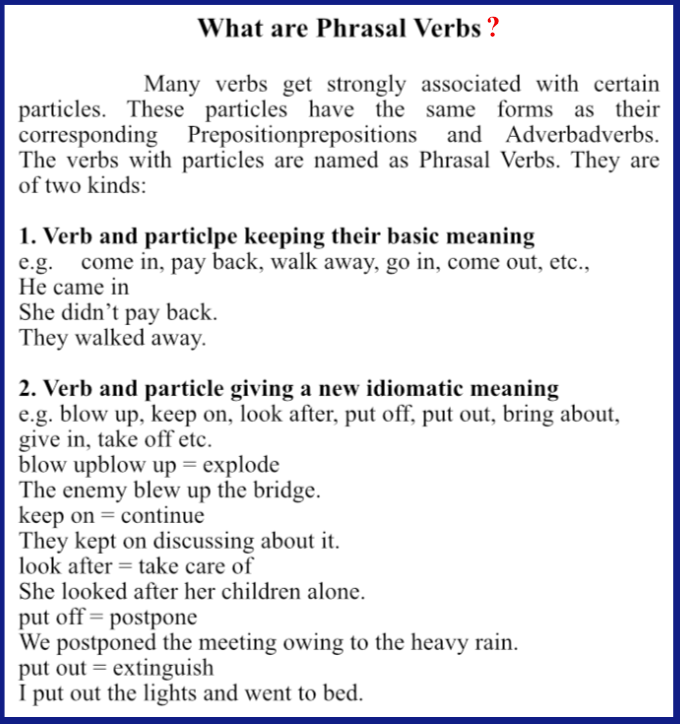
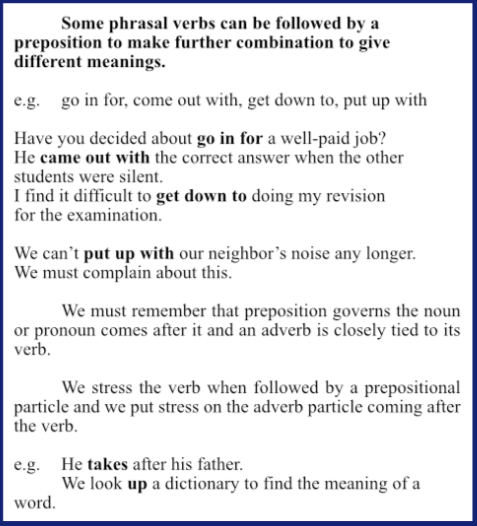
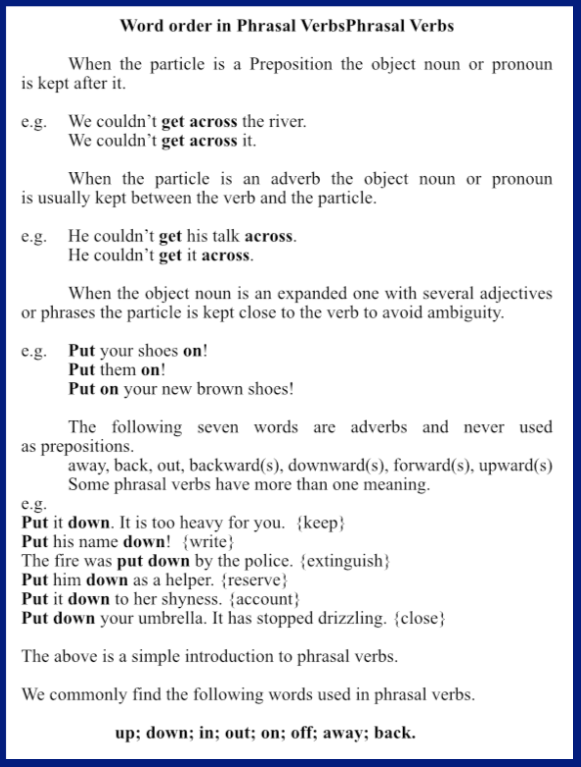
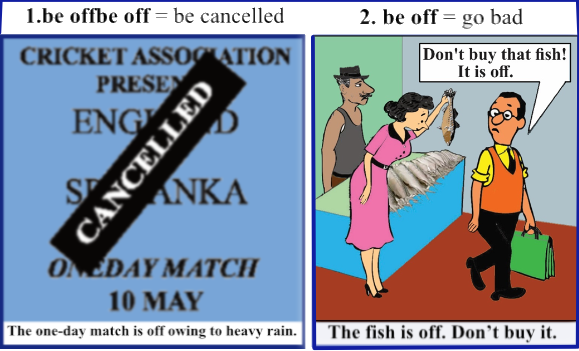
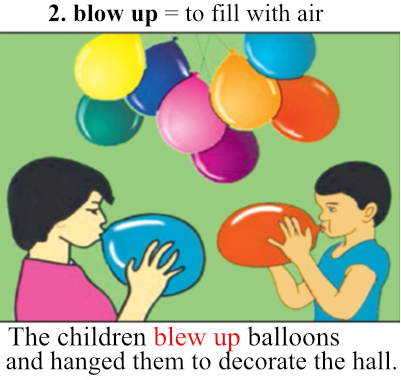
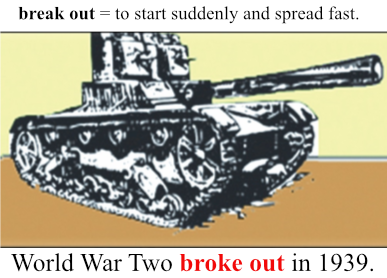
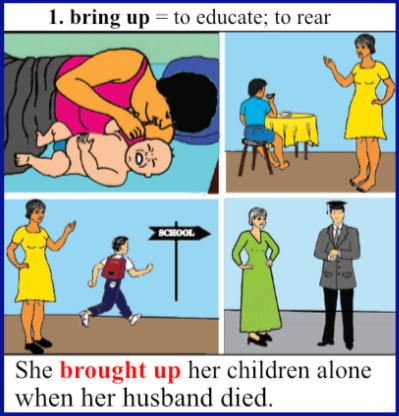
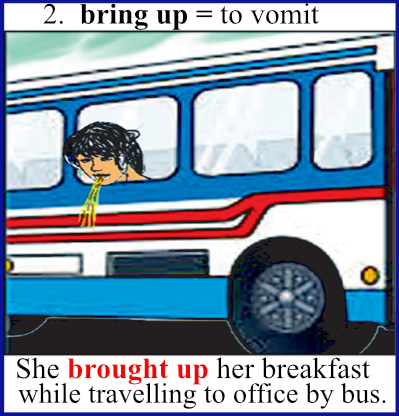
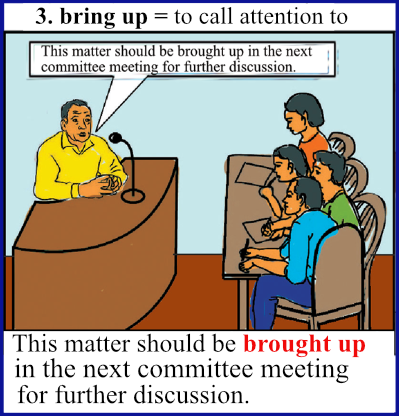
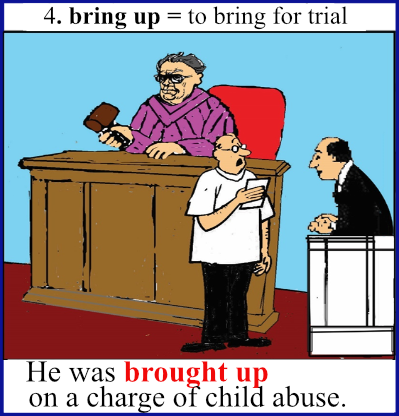
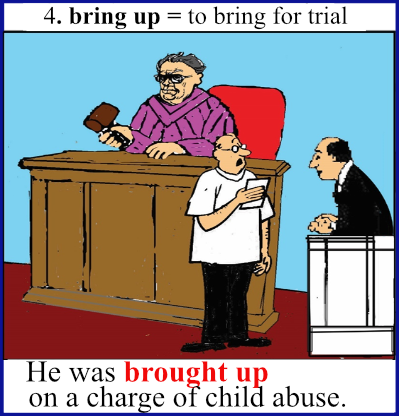
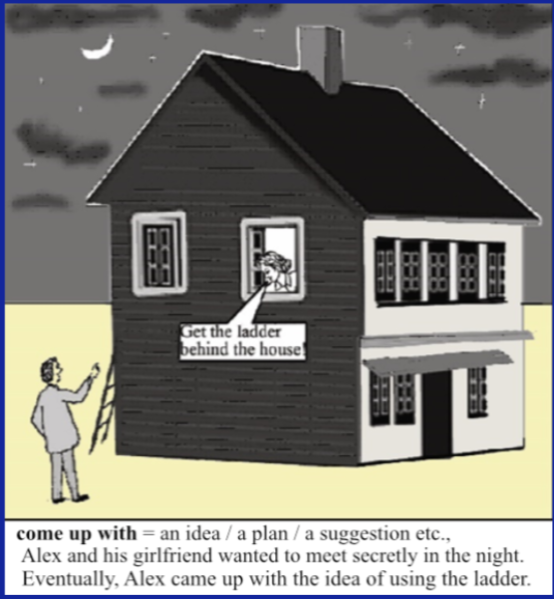
Text panel "What are Phrasal Verbs": verbs with particles, e.g. blow up = explode, put off = postponeText panel on phrasal verbs followed by a preposition, e.g. go in for, put up withText panel on word order in phrasal verbs, e.g. "Put your shoes on!" and "Put it down."Two panels for be off: a cancelled cricket match poster and "Don't buy that fish! It is off."Bridge exploding: "blow up = to destroy by explosion. The terrorists blew up the bridge last night."Children blowing balloons: "blow up = to fill with air. The children blew up balloons"Army tank: "break out = to start suddenly and spread fast. World War Two broke out in 1939."Mother raising a child in four panels: "She brought up her children alone when her husband died."Woman vomiting from a bus window: "She brought up her breakfast while travelling to office by bus."Man at a committee meeting: "This matter should be brought up in the next committee meeting"Judge with a gavel and a man in the dock: "He was brought up on a charge of child abuse."Judge with a gavel and a man in the dock: "He was brought up on a charge of child abuse."

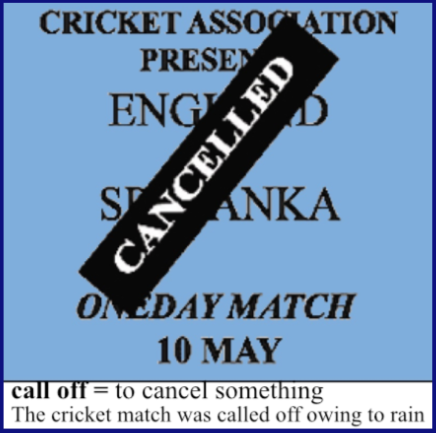
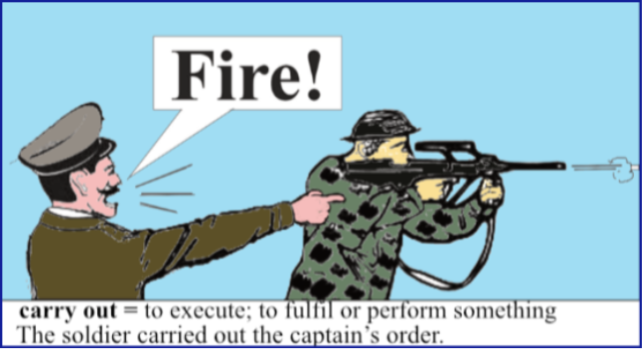
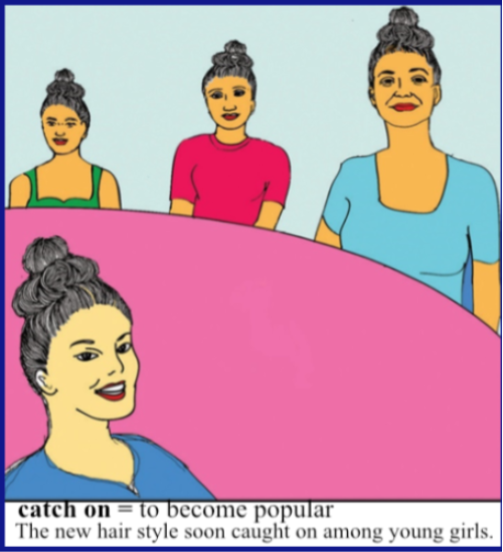
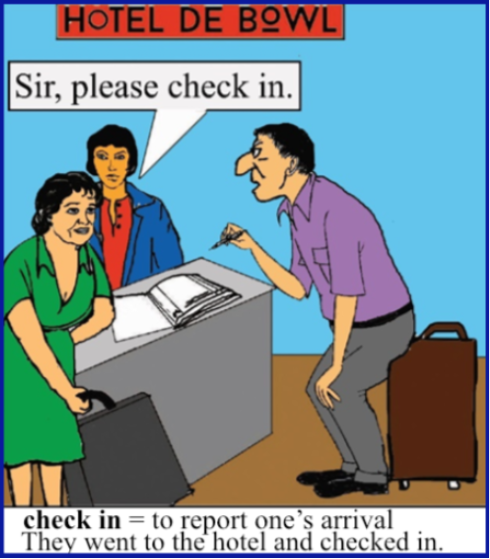
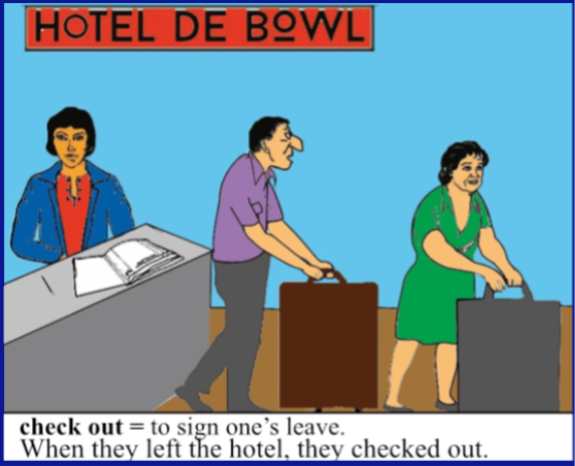
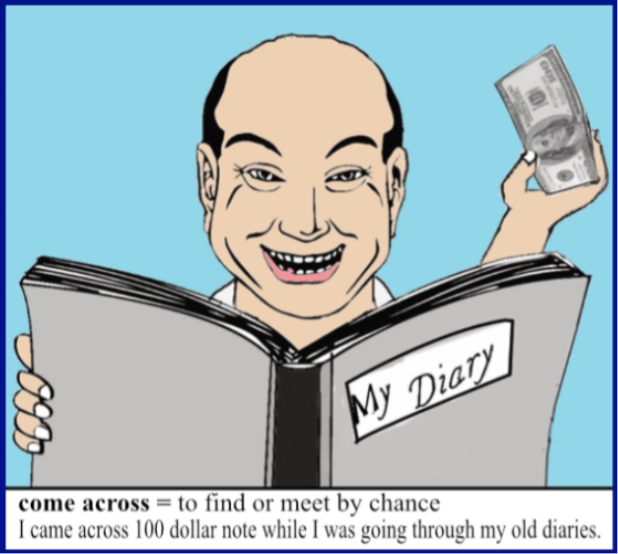
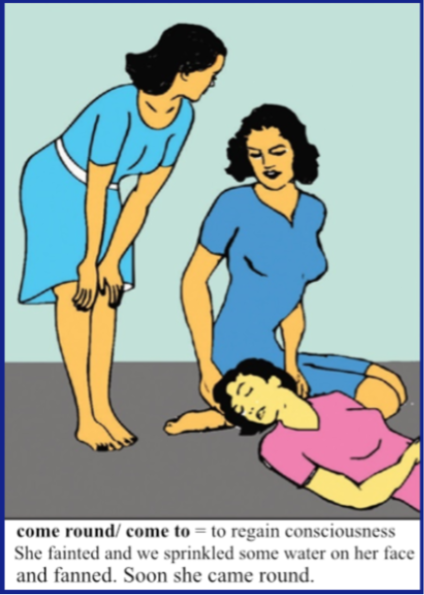
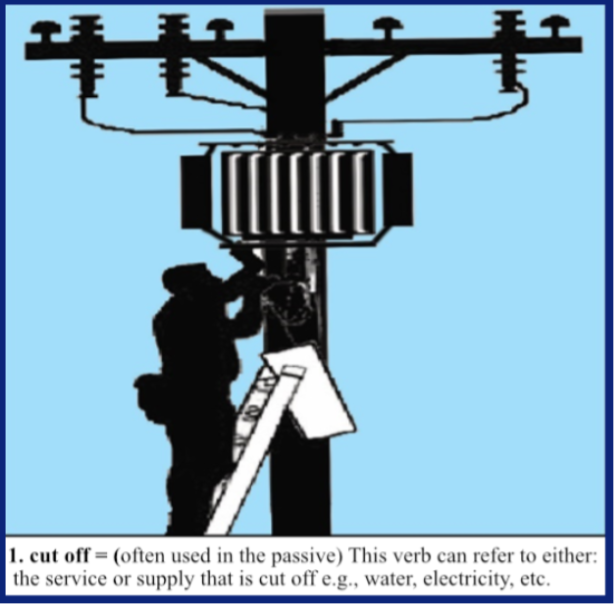
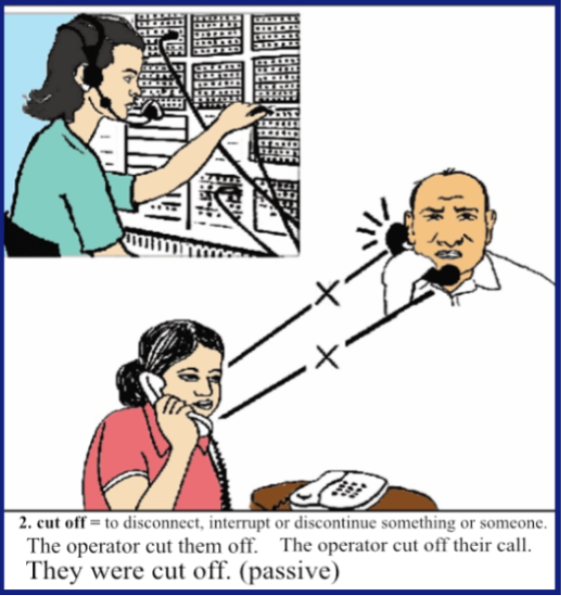
Cancelled cricket match poster: "call off = to cancel something. The cricket match was called off owing to rain"Captain shouts "Fire!" to a soldier: "The soldier carried out the captain's order."Young women with the same hairstyle: "The new hair style soon caught on among young girls."Guests at a hotel desk: "Sir, please check in." "They went to the hotel and checked in."Guests leaving a hotel with luggage: "When they left the hotel, they checked out."Smiling man with a diary and a banknote: "I came across 100 dollar note while I was going through my old diaries."Two women help a fainted girl: "She fainted and we sprinkled some water on her face and fanned. Soon she came round."Man with a ladder at night by a girl at a window: "Alex came up with the idea of using the ladder."Worker on a ladder at an electricity pole: "cut off = the service or supply that is cut off"Operator at a switchboard and two callers: "The operator cut them off. They were cut off. (passive)"

GET

‘GET’ is a very commonly used verb in English and has many different uses and meanings. The main uses are given below with some examples.

GET

1.get = become

He got wet coming in the rain.

She got excited when she heard the news.

He got tired carrying the heavy bag.

He got weak after his illness.

She got married late.

  1. get = cause to be

She got the children ready to go to the party.

He got the breakfast ready.

Sam got all the sentences in the exercise right.

Has he got his sum right?

He got his leg broken when he fell off the bicycle.

  1. get = reach the stage of doing something

Get going! Start!

It is time we got going.

The project hasn’t really got going yet.

When she gets talking, she goes on for hours.

  1. get = bring to do something

We can easily get the children talking.

Can you get this old wall clock going again?


  1. get = reach the stage one knows or feels

When you get to know her, you will like her.

They soon got to be friends.

Someday you get to realise your own faults.

How did you get to know that I was here?

  1. get = cause to do something in a certain way

You will never get him to realise his foolishness.

You will never be able to get her to talk.

We can’t get that boy to do it properly.

I must get somebody to cut down this tree.

  1. get = receive, have, obtain

I got your letter yesterday.

I will come and see you when I get time.

He got leave to go home.

Where did you get that nice shirt?

He gets his living by selling lottery tickets.

Can you get all the TV channels on your TV set?

Go and get your lunch before going out to play.

Get me a seat if you go early.

How did you get this? It is mine. I lost it yesterday.

While playing cricket, he got a nasty blow on the head.

The soldier got the bullet in the arm.

  1. get = catch an illness

The boy got chickenpox.

I got a very bad cold.


  1. get = receive punishment

The murderer got 12 years’ imprisonment.

If you come late again, you will get told off.

  1. get = understand

I don’t get your explanation.

He didn’t get my joke.

You have got it wrong.

Speak a little louder. I didn’t get your answer.

I have got you there!

That point has got him!

GET

Continued

  1. get = posses

I have got a new bicycle.

We have got a pet dog.

What a comfortable room you have got!

12 get = compel to do something

I have got to finish the job today itself.

We have got to go now. The train leaves in one hour.

He has got to work very hard for his living.

It’s a holiday today. We haven’t got to go to school.

I got to meet him yesterday.

I usually get to bed very late.

Where has she got to?

A bicycle makes it easier to get about.

The bridge had collapsed, and people couldn’t get across.

Can you get over the wall?

He got back home very late.

When did you get back home?

He got off his bike and talked to her.

I am getting off at the next bus stop.

Get off the grass!

Wait to have dinner with us. I will get you back.

Get your shoes on and get ready to go for a walk.

You can learn how to use the verb ‘GET’ to give different meanings by studying the story given below.

Who is to be blamed?

Jeff was a very clever and intelligent boy. He got all the good qualities from his parents. He regularly got up very early, got his breakfast and got to school on time. The teachers got to know his good qualities and intelligence. They got him to do his studies well and got him through all his examinations. He got through his Advanced Level examinations, getting ahead of all the students at the school. He got into a university and got a degree. Immediately, he got a well-paid job as the manager of a big company. He never got above himself and got on well with his staff. Everybody got along with him. A few years later he got a luxurious house and got married.  The couple got on very well.


He got down to work very hard to get more profit for the company, and he got a new secretary.  She was got up like a film star when she came to the office. She got off with him little by little and got friendly with him. She managed to get money out of him. One day, he got around to going on a business tour to Japan. A month later, he found that his secretary had got pregnant. The secret somehow got out. His wife got to know about this and got divorced.  His secretary also left him. He got lonely. He got frustrated. So, one day he decided to drink. He got drunk and, on the way back to his house, he got sleepy and got into a serious car accident. He got a good lawyer, got one witness, and tried to get away, but he got a one-year jail sentence.

When he got out, he tried to get a job. He got through all his money, sold his house, and got a room on rent. He got into drinking and gambling. So, he got poor and got into debt. He got behind on his rent, and then he got evicted. So, he got depressed, couldn’t get over his sorrow and got addicted to drugs. He got involved in crime to get drugs. He got caught several times, but he was able to get away every time. He got old and got sick. Nobody cared about him. Everything got worse. He got desperate. One day an old prison mate saw him and made a joke by saying, “Oh Jeff, no! How did you get so young and handsome?” He couldn’t get the joke and got very angry. They got into a fight. He got seriously wounded and got killed.

(By Amarasiri Ganewatta)

You can learn the meanings of phrasal verbs and how to use them by referring to a good dictionary.



Amarasiri Ganewatta

Amarasiri Ganewatta

Director, English Language Laboratory

Amarasiri Ganewatta is the director of the English Language Laboratory. He is a retired English teacher and a language translator living in California, USA.

Email: ganewatta@gmail.com

Books by the Author

Understanding Advanced English Grammar 1 in 3D by Amarasiri Ganewatta, book cover

‘UNDERSTANDING ADVANCED ENGLISH GRAMMAR’ is the first book of a series of three books. This book begins with the introduction of the three dimensions of the English language. It is an innovative method of teaching Active Voice, Passive Voice and Causative uses looking at an action in three different angles.

Available at Amazon
English Interrogatives by Amarasiri Ganewatta, book cover

ENGLISH INTERROGATIVES

Interrogative words may be used in direct questions as well as in indirect questions. They are also used as Relative Adverbs and Relative Pronouns. Therefore, we must have a clear understanding of how to use these very important ‘Wh’ words in English. This book covers all the important usages of interrogatives for the benefit of all users.

English Through Pictures by Amarasiri Ganewatta, book cover

It is clearly shown how the verbs ‘Be’, ‘Have’ and ‘Auxiliary Verbs’ control the flow of time in the English language. All these subtle things can never be grasped by a simple explanation with words. Therefore, the ‘ENGLISH through PICTURES’ book has so many illustrations drawn to give the finer points that all users of English should know.

Exploring Grammar World 1 by Amarasiri Ganewatta, book cover

EXPLORING GRAMMAR WORLD 1      The verb illustrated in the book as a family of five (father, mother and three little children) is one creative idea which will help to solve the grammar problems about the behaviour of the verb.

‘EXPLORING GRAMMAR WORLD 1’is the first book of a series of books. The author of this book has been teaching languages for nearly five decades to learners of all ages, from primary and secondary to higher education and even to elderly people. The experience gathered in teaching helps the author in developing a new method of teaching language.
          Grammar is like the skeleton of the human body. If there is any deformation in any part of the skeleton, the others will immediately notice it. In the same manner, if ever you make any grammatical mistakes, your audience will notice it. That is why learning grammar is highly important as a language skill.
   

Exploring Grammar World 2 by Amarasiri Ganewatta, book cover

 ‘EXPLORING GRAMMAR WORLD 2’teaches you how to ask and answer all types of questions.
A successful life flourishes on the never-ending drive to understand the ‘Why’ and ‘How’. This urge leads to continuous learning and reshapes how we live, work, learn and engage in day-to-day affairs. This book ‘EXPLORING GRAMMAR WORLD 2’ will fulfil your desire.

Exploring Grammar World 3 by Amarasiri Ganewatta, book cover

‘EXPLORING GRAMMAR WORLD 3’ brings you the most important English sentence patterns. In the first chapter of the book, two Idiomatic expressions, ‘There is/ are, and It is/was/ had been/ will be’ are given with many examples.  Chapter two in the book opens a new door to the conditional world. Conditional Clauses (If clauses) can be put into four categories as 1. Possible Conditions, 2. Probable Conditions, 3. Impossible Conditions, and 4. Zero Condition. There are other conditional sentence patterns too, for expressing Imaginary and Unreal situations. All these Conditional Sentence Patterns are given with examples and illustrations which will help you to remember them easily. For your guidance, relevant exercises are also included. You will find the Answer key at the end of the book.

Five Funniest Stories by Amarasiri Ganewatta, book cover

The stories in this book are full of funny imaginary dialogues, helping the readers to improve their ability to use fun in their day-to-day conversation and are beneficial for developing language skills. Another benefit is that they help readers understand the importance of basic moral values such as politeness, kindness, generosity, and sympathy.

Great Grammar Guide by Amarasiri Ganewatta, book cover

This book contains all the grammar rules, usages, sentence patterns of active voice, passive voice, and causative, English sound system, numbers and counting, nouns, gerunds, prepositions, adjectives, reported speech, word order in sentences, accepted phrases, homophones, phrasal verbs, essay writing, punctuation, English for day-to-day activities, language exercises and an answer key to the exercises.

Know-How English Grammar by Amarasiri Ganewatta, book cover

All the grammar rules are filters used before our eyes and ears for purifying the language we hear and see. The more filters you have, the better knowledge and ability you have to see and read the world as it is. This book provides you with the finest filters you wish to have, giving you the best grammar knowledge.

Revolutionize Learning Grammar by Amarasiri Ganewatta, book cover

‘REVOLUTIONIZE LEARNING GRAMMAR’ is a book which shows how all the Active Voice, Passive Voice and Causative tenses are used in English. We acquire the ability in our childhood to use language to communicate through a set of sounds, gestures, or written words and learn to convey messages, ideas, feelings, and emotions to people who use the same language. If you know the basic grammar rules of your first language, it is quite easy to learn English grammar by using this book because it is the only grammar book which shows the three dimensions of language, helping you to read the world as you see. This book will definitely revolutionise your learning English.

Time and Tenses: The Fourth Dimension by Amarasiri Ganewatta, book cover

There are 44 sentence patterns in English to show the flow of time in the three dimensions: Active Voice, Passive Voice, and Causative. The relevant sentence patterns are given with many examples and illustrations so that anyone who uses this book will be able to convey all subtle feelings and desires using English without any confusion. This book has been written after many years of observation, analysis, and research using several methods and hundreds of illustrations to present how time and tense work in the English language.

44 English Phonics by Amarasiri Ganewatta, book cover

This book provides help for beginners to improve their standard pronunciation greatly because it gives all the sounds of vowels and consonants with examples and relevant illustrations.

Perfect English Grammar in 3D by Amarasiri Ganewatta, book cover

The practice lessons given in this book with illustrations will help to solve all the grammar problems of the students who are learning English as a second language. This book provides you the knowledge necessary to master the three dimensions of English grammar.

English Grammar Through Pictures by Amarasiri Ganewatta, book cover

If you know the basic grammar rules of your first language, it is quite easy to learn English grammar by using this book because it is the only grammar book which shows the three dimensions of language with hundreds of lively illustrations helping you to read the world as you see. This book will definitely revolutionise your learning English.

Understanding Advanced English Grammar 1 in 3D Through Pictures by Amarasiri Ganewatta, book cover

Once you follow the lessons in this book, you will find that English grammar is easier than any other grammar.

Understanding Advanced English Grammar 2 in 3D Through Pictures by Amarasiri Ganewatta, book cover

There are sixteen active voice tense patterns in the English language, and all these patterns are given with examples and illustrations in this book. They will help solve all the grammar problems pertaining to the usage of English tenses.

Understanding Advanced English Grammar 3 in 3D Through Pictures by Amarasiri Ganewatta, book cover

   All the relevant sentence patterns with illustrations are given in this book so that readers can use English without any grammar difficulties. Appropriate exercises and Answer Keys will help you to test your grammar knowledge in the fields of Adverbs, Conditional Clauses, and Reported Speech.

Lazy Jack by Amarasiri Ganewatta, book cover

LAZY JACK is a book full of colourful illustrations and interesting dialogues suitable for young children to motivate novel visions about life. The original story LAZY JACK was written by James Orchard Halliwell-Phillipps (1820 – 1889), who was a great literary figure and contributed much to English literature. By collecting traditional stories and nursery rhymes, he did a great service to the children of the world.

English Phrasal Verbs Through Pictures by Amarasiri Ganewatta, book cover

ENGLISH PHRASAL VERBS THROUGH PICTURES is a book with a new vision. Phrasal verbs are very useful for expressing one’s feelings with emotions.  The English language is rich with many phrasal verbs that are constantly used in everyday communication. The learners will be able to keep all the phrasal verbs in mind as visuals and forget about the words and sentences; just try to remember the illustrations given. Close your eyes, and the words and sentences will appear in no time. Emotions cannot be seen but felt.  ENGLISH PHRASAL VERBS THROUGH PICTURES will help you to express your emotions colourfully.